




Picture the last week of the month. Rent already went out, the gas bill is due Thursday, and the checking account balance is sitting somewhere it shouldn't be. That ordinary moment, with no drama in it at all, is where most first-time payday borrowing starts. So why do people borrow money?
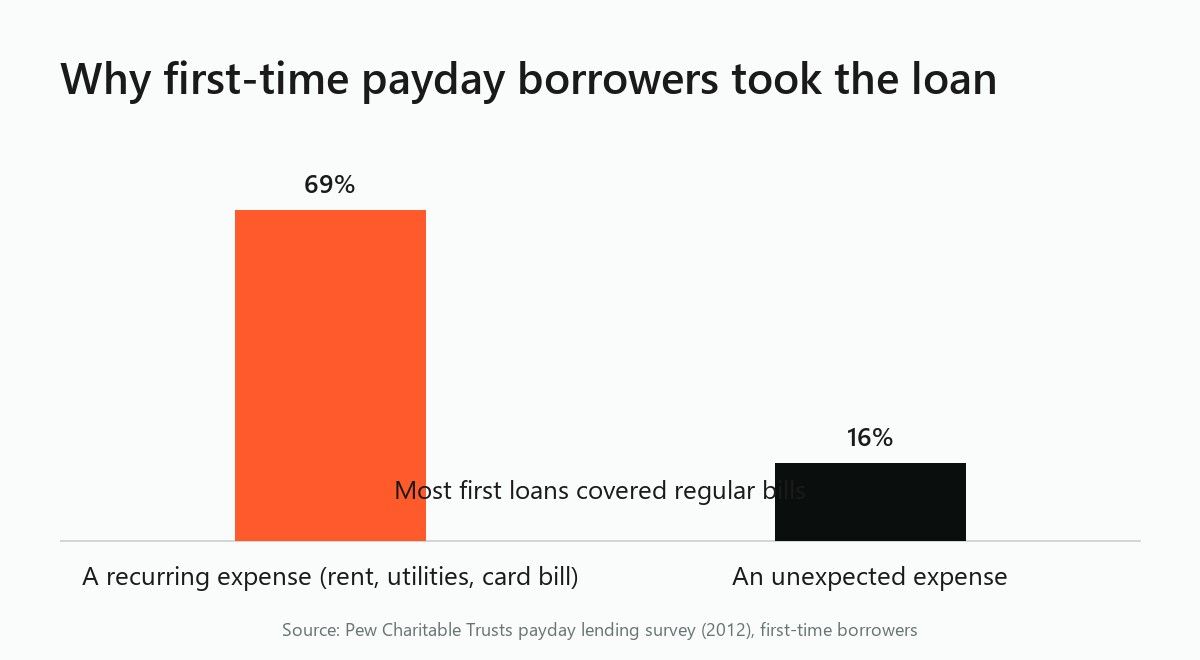
When researchers at Pew Charitable Trusts asked first-time payday borrowers why they took out the loan, 69% pointed to a recurring expense like utilities, a credit card bill, or rent. Only 16% named something unexpected, like a medical bill, according to Pew Charitable Trusts' 2012 survey, "Payday Lending in America: Who Borrows, Where They Borrow, and Why". Pew's own conclusion was that these loans mainly cover everyday living expenses.
The gap between what people assume ("this is emergency money") and what the data shows ("this is bill money") matters more than it sounds like it should. It changes what fixes the problem. If you're trying to figure out why you, or someone you love, keeps reaching for a loan every month, for many people the answer is income that runs out before the bills are covered, month after month, and that calls for a different fix than a one-off shock.
I've sat across the table from a lot of people asking themselves this exact question, and the honest answer often surprises them. They expect to hear that they overspent on something they shouldn't have. What they usually find instead is income that runs out before every bill gets covered, month after month, with no bad decisions required to get there. That shortfall alone is enough to send someone looking for a loan.
The $400 Test the Federal Reserve Runs Every Year
The Federal Reserve has a blunt little question it asks American households once a year, as part of its Survey of Household Economics and Decisionmaking: could you cover a $400 emergency expense using cash or its equivalent? In the 2025 survey, 63% of adults said yes. That number held flat from 2024 and sits below the 68% peak measured in 2021, per the Federal Reserve Board's "Report on the Economic Well-Being of U.S. Households in 2025".
Flip that number around and you get the part that matters for this article: roughly 37% of adults could not cover a $400 shock with cash on hand. That's more than a third of the country standing one flat tire away from needing to borrow, use a credit card they can't immediately pay off, or skip something else to cover it.
Here's what that statistic doesn't tell you, and it's important: it doesn't say why those people can't cover $400. Is this the first time you've faced a surprise like this with no cushion built up, or does your income already get swallowed by routine expenses most months, leaving no room to set aside $400 in the first place? That's a question only you can answer, and it's the one the rest of this article helps you work through.
The Fed's survey only measures the symptom. Diagnosing the cause is yours to do, using the framework below.
What Happens When a Recurring Gap Gets Treated Like a One-Time Emergency
This is where the CFPB's research comes in, and it's the piece that ties Pew's "why" and the Fed's "who's at risk" together into something you can act on. The Consumer Financial Protection Bureau, the federal agency that regulates payday lending disclosures and consumer financial products, studied actual borrowing patterns. It found that nearly half of payday borrowers take out more than ten loans a year, and 14% take out 20 or more, per the CFPB's "Payday Loans and Deposit Advance Products," April 2013. The same report found borrowers were in debt for a median of 199 days, roughly 55% of the year, and that a lot of them take out a new loan soon after the last one closes.
Sit with that for a second. A car accident happens once. A surprise medical bill happens once, maybe twice if you're unlucky. More than ten loans in a single year points to something else entirely.
Ten to twenty loan transactions in twelve months is what it looks like when income keeps running out before the bills are covered, patched over and over with the same tool, because the tool is fast and the underlying shortfall never got fixed. That fits Pew's finding: if most first-time payday borrowers are covering routine bills, repeat borrowing is what you would expect, because the bill comes due again next month, right on schedule.
Put the three data points next to each other and a pattern emerges that none of them show on their own. Most first-time payday borrowing starts with a recurring bill rather than a crisis. Roughly 37% of adults couldn't cover a $400 expense with cash or its equivalent. And once someone starts borrowing to cover that gap, the pattern tends to repeat for months on end.
This is what happens when income and fixed costs stop lining up, and nobody steps in to realign them.
The Framework: Emergency or Gap?
You don't need a financial degree to sort this out. You need four honest questions, answered about a typical month for your own situation. Grab a piece of paper or open a notes app and write down your answers. Vague answers produce vague plans, and the point of writing them down is to catch yourself the moment your answer starts sliding toward what you wish were true instead of what usually happens.
1) Has this exact type of expense hit more than once in the last six months? A transmission that failed once is an emergency. A phone bill you've been short on three of the last six months is a recurring cost your income currently can't absorb.
2) Does your regular income cover your routine bills most months, or almost never? Be specific here: I use four of the last six as my own line for "most months." If you're honestly closer to "almost never," that's a structural shortfall, and a single loan just moves this month's version of the problem into next month.
3) If this expense disappeared tomorrow, would your budget be stable, or would something else take its place? This is the test that separates a true one-off from a symptom. If paying off this one bill would leave you breathing easy, you're likely dealing with a true emergency.
4) Did you see this coming, and could you have planned for it? Rent lands on the same day every month, so it's never a surprise. A burst water heater usually is. Sorting expenses into "predictable" and "not predictable" tells you which bucket you're in.
If your answers point mostly toward "first time," "most months are fine," "this one bill was the whole problem," and "I couldn't have seen this coming," you're likely looking at a genuine one-time emergency. If your answers point toward "this keeps happening," "almost never," "something else always fills the gap," and "I could see this coming, I just didn't have the room for it," you're dealing with a recurring budget gap. Those two situations call for different plans, and treating a recurring gap like a one-time emergency is how you end up in the ten-loans-a-year pattern.
Let's run it through an example. Say your car needs a $350 repair this week. You answer the four questions: this is the first car repair you've needed in over a year, your paycheck has covered your routine bills in five of the last six months, paying this one bill off would leave your budget stable again, and you didn't see it coming. That's a one-time emergency, full stop, and it calls for the emergency-fund and no-new-debt plan below.
Now say instead it's a $350 electric bill that's been creeping up for the third month running, you've been short on routine bills in four of the last six months, and even without this bill something else, groceries or a car payment, would still be tight. That's a recurring gap, and the fix looks completely different: it calls for restructuring your budget so the shortfall stops repeating.
If It's a Genuine One-Time Emergency
Good news first: a true emergency has a clean fix, even if it doesn't feel like it in the moment. The goal is to cover this one gap without creating a second, ongoing one.
Start with what you already have. Check any savings, even a small buffer, before you look at borrowing at all. If you don't have that buffer yet, building one now helps you handle the next version of this moment without it turning into a crisis. Our guide on how to build an emergency fund on a low income lays out a realistic path to get there even on a tight budget, starting from zero.
Next, before signing up for any loan, check whether local utility assistance, charities, or other community and nonprofit resources can cover part of the expense.
If you do need to borrow to bridge a true one-time gap, avoid the most expensive options if you have any choice in the matter. A payday loan should be your last resort, because the cost of borrowing that way can turn a one-time problem into an ongoing one if the repayment doesn't fit your next paycheck cleanly.
If It's a Recurring Budget Gap
This is the harder conversation, but it's also the one with the bigger payoff, because fixing it once means you stop having this same conversation every month. A recurring gap means your income and your fixed costs don't line up, and a single loan only delays that math without solving it. Every dollar you borrow now to cover this month's shortfall still has to come from a future paycheck that already has its own bills waiting on it, which is how the CFPB's repeat-borrowing pattern gets started in the first place.
The real fix is restructuring how you budget, especially if your income varies week to week. If you work hourly, tipped, or gig shifts, a budget built for a steady paycheck often falls short, because it assumes money that isn't reliably there. Our piece on how to budget on irregular or hourly income walks through a system built specifically for income that swings, rather than one borrowed from a 9-to-5 world that doesn't apply to your paycheck.
If you're already inside a cycle where you're borrowing to repay a previous loan, that's the CFPB's more-than-ten-loans-a-year pattern showing up in your own life. Getting out of it takes a deliberate plan. Our step-by-step guide to breaking the payday loan rollover cycle lays out exactly how to unwind it without falling straight back in.
And if borrowing is truly unavoidable while you work on the underlying gap, look at cheaper options before a payday loan. A Payday Alternative Loan (PAL) from a credit union is the first cheaper option to compare. It's one of several payday loan alternatives worth comparing before you commit to anything.
Your Next Step This Week
Pull out those four questions again and answer them about whatever expense brought you to this article. Honest answers, nothing fancy. That's the diagnosis.
Once you know whether you're standing in front of a genuine emergency or a recurring gap, the next move becomes a concrete plan you can follow through on. Pick the section above that matches your answers, and take the first step in it before the week is out. If you're not sure which bucket you fall into after answering the four questions honestly, default to treating it as a recurring gap. That assumption costs you little if you're wrong, and it saves you a repeat of this exact situation next month if you're right.
Frequently Asked Questions
Why do most people take out their first payday loan?
According to Pew Charitable Trusts' 2012 survey of first-time payday borrowers, 69% cited a recurring expense such as utilities, rent, or a credit card bill as their reason for borrowing, and 16% cited an unexpected expense like a medical bill. In other words, most first-time payday borrowers were covering routine bills.
Can most Americans cover a $400 emergency expense?
Yes, but not by a wide margin. The Federal Reserve's 2025 Survey of Household Economics and Decisionmaking found that 63% of U.S. adults could cover a $400 emergency using cash or its equivalent, meaning roughly 37% could not, a figure that has stayed essentially flat since 2024.
How often do payday borrowers take out repeat loans?
The Consumer Financial Protection Bureau's 2013 study of payday and deposit advance products found that nearly half of borrowers take out more than ten loan transactions per year, and 14% take out 20 or more, with a median of 199 days spent in debt over that year.
How do I know if I have a budget gap instead of a one-time emergency?
Ask whether this exact type of expense has hit more than once in the last six months and whether your income covers routine bills most months or almost never. If the expense keeps repeating and your income rarely stretches far enough, you're likely facing a recurring budget gap that calls for restructuring your budget.