




South Carolina payday loan laws are narrower than most borrowers expect. State law caps a single payday loan, known formally as a deferred presentment transaction, at $550, limits the fee to 15% of the amount you borrow, and requires the lender to check a real-time state database before handing you the money.
These protections sit in S.C. Code Title 34, Chapter 39, the Deferred Presentment Services Act, and they are enforced by the State Board of Financial Institutions (BOFI). That's the law today, and it applies whether you're in Charleston, Columbia, or Rock Hill.
A pending bill would eventually change most of this. It hasn't passed. More on that further down, because getting the timeline right matters if you're deciding whether to borrow this week.
What South Carolina Law Actually Caps: $550 and 15%
Under S.C. Code § 34-39-180(B), a licensed lender cannot issue you more than $550 in an outstanding deferred presentment transaction at one time. That's a hard ceiling, not a suggestion. Ask for $700 and a compliant lender has to turn you down.
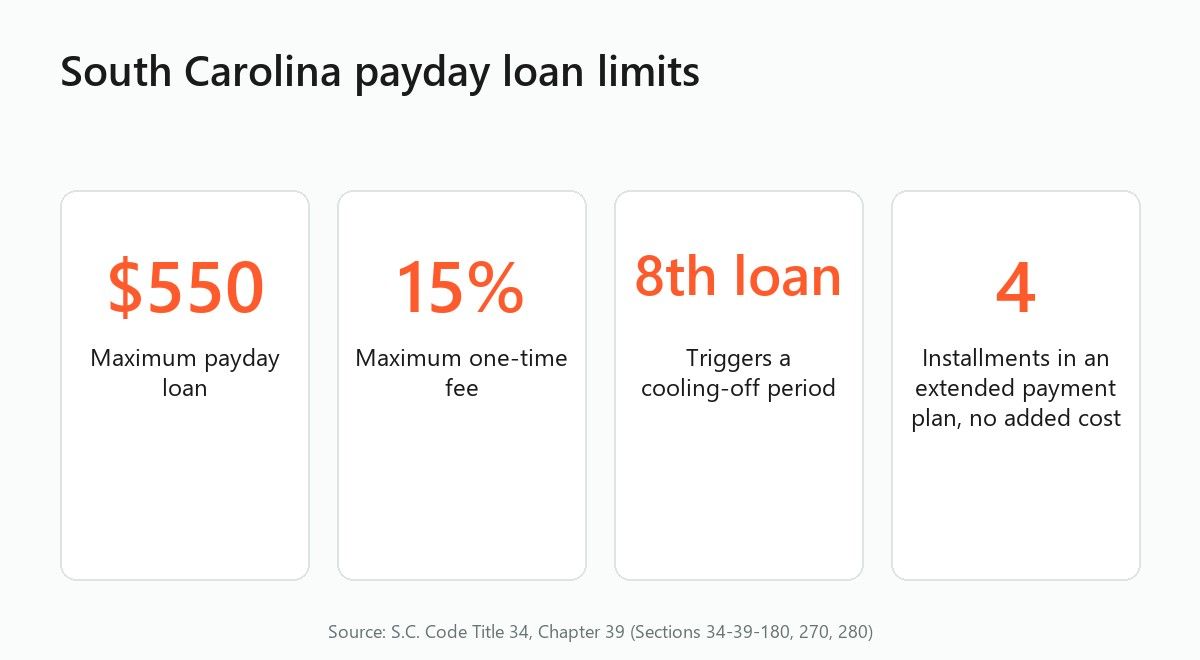
The fee side is just as specific. Section 34-39-180(E) of the same chapter caps the fee at 15% of the principal, charged once per agreement. On the maximum $550 loan, that's a fee of $82.50.
The fee doesn't compound and it doesn't reset on renewal. Under § 34-39-180(E), it's charged once per agreement, full stop. The Extended Payment Plan described below is your penalty-free alternative if you can't pay it off.
Compare that structure to a state with no dollar cap at all, and South Carolina looks disciplined. Compare it to a state that caps payday APR outright, and the picture looks different: if the loan runs two weeks, a 15% fee works out to roughly 390% APR. Both things are true. The cap controls the dollar cost of one loan; it doesn't touch what that fee works out to as an annual percentage.
The One-Loan-at-a-Time Database Rule
South Carolina's real teeth are in its database requirement. BOFI maintains what the statute calls "a common database with real-time access through an internet connection," and every licensed deferred presentment lender has to check it before approving a new loan.
S.C. Code §§ 34-39-175(A) and 34-39-270(A)(1)-(2) prohibit a lender from issuing you a new deferred presentment loan if you already have one outstanding, or if you repaid a prior one that same business day.
In practice, this closes the door on stacking. You can't walk into one storefront, take out $400, then walk into a second storefront across town and take out another $400 the same afternoon. The database sees the first loan the moment the second lender tries to check you in. That's the single biggest structural difference between South Carolina and states that let borrowers hold loans from multiple lenders at once, and it's worth knowing before you assume a second loan will simply cover the first.
The Eighth-Loan Cooling-Off Trigger
South Carolina also limits how fast you can cycle back into a new loan after repeated borrowing. Under S.C. Code § 34-39-270(B), once you've taken seven deferred presentment loans within a calendar year, an eighth loan cannot be issued on the same day or the next business day after you repay the seventh.
The law forces a gap once repeat borrowing hits that threshold. It won't stop you from taking an eighth loan eventually, but it stops the instant back-to-back cycle that turns a short-term loan into a permanent monthly bill. Noticing you're on loan five or six for the year is worth pausing on before the count climbs higher.
Your Right to an Extended Payment Plan
This is the protection most borrowers don't know they have. Under S.C. Code § 34-39-280, if you can't repay a deferred presentment loan on its due date, you can elect an Extended Payment Plan (EPP) once every twelve months.
The lender has to let you repay the loan in at least four substantially equal installments, and it cannot charge you any additional fee or interest for using the plan. Licensees are required to post notice of this right where borrowers can see it.
Say that plainly to the lender when you're behind: "I want to use my Extended Payment Plan under South Carolina law." You're not asking for a favor. It's a right the statute gives you, once per year, at no added cost. A lender that refuses it or tries to charge you for it is violating Chapter 39, and that's exactly the kind of complaint BOFI wants to hear about.
Who Regulates This, and How to Check a Lender's License
The State Board of Financial Institutions licenses and supervises every deferred presentment provider in South Carolina under S.C. Code § 34-39-130(A). BOFI is the agency that issues licenses, runs the common database, and takes enforcement action against lenders who break Chapter 39.
The South Carolina Department of Consumer Affairs (SCDCA) handles broader consumer education and complaints under the state's general Consumer Protection Code, but BOFI is the licensing and enforcement body for payday lending specifically.
This isn't a legal gray zone where anything goes. A willful violation of the licensing requirement under Chapter 39 is a Class B misdemeanor, and each unlawful transaction counts as a separate offense.
Before you borrow from any storefront or online lender claiming to operate in South Carolina, you can ask to see its BOFI license number, or contact BOFI directly to confirm it. If a lender won't produce one, that's your answer.
The Other Track: Supervised Lender Installment Loans Under Title 37
Here's where a lot of general "South Carolina payday loan" content gets sloppy. Not every short-term lender in this state operates under the deferred presentment statute. South Carolina separately licenses "supervised lenders" under Title 37, Chapter 3 of the Consumer Protection Code, and these lenders make installment loans under a different rate structure than the $550/15% payday framework.
The definition sits at S.C. Code § 37-3-501, and the licensing requirement at § 37-3-503.
Many South Carolina payday storefronts also hold, or have switched to, a supervised lender license, which lets them offer installment loans instead of (or alongside) deferred presentment loans. That's a meaningfully different product. An installment loan under Title 37 repays in installments, with its own rate rules, instead of the single balloon payment structure a deferred presentment loan uses.
A storefront quoting loan terms that don't match the $550 cap or the 15% fee limit is worth a direct question: which statute does this loan fall under? You may be looking at a supervised loan, not a Chapter 39 payday loan, and the math behind it is different.
BOFI's statutory role extends to Title 37 supervised lenders as well, so the same agency has a hand in both markets even though the products are regulated separately.
What's Changing: The Pending S.379 Repeal, Not Yet Law
A bill introduced in the South Carolina Senate on February 25, 2025, and referred to the Senate Banking and Insurance Committee, would repeal Chapter 39 outright. Senate Bill 379 would stop new deferred presentment loans after a mid-2025 cutoff, revoke existing deferred presentment licenses on December 31, 2025, and repeal Title 34, Chapter 39 entirely effective January 1 of the following year. Those are the dates as introduced in the bill, and as of this writing they've already passed without S.379 advancing beyond committee.
The bill would let current deferred presentment licensees transition to supervised lender status through the Nationwide Multistate Licensing System at no cost before the cutoff.
As of this writing, S.379 has not passed. It's sitting in committee, which means it has not become law, and Chapter 39 remains the fully operative statute governing every number in this article: the $550 cap, the 15% fee limit, the database rule, the eighth-loan trigger, and your Extended Payment Plan right.
A headline about the bill shouldn't convince you these protections have already changed. They haven't, not yet. Researching this topic later than late 2026 means checking the bill's status again before assuming either the old rules or the repeal is currently in effect, since legislative status shifts and this page reflects where things stood at the time of writing.
Should the repeal eventually pass, the practical effect for borrowers would be straightforward: deferred presentment payday loans would stop being issued in South Carolina, and the storefronts that continue operating would do so as Title 37 supervised lenders instead, under installment loan rules rather than the payday framework described above.
Payday Loans in Rock Hill and York County
Searching for a payday loan in Rock Hill, South Carolina, or anywhere else in York County turns up the same answer: the same statewide rules covered in this article apply there. The same Title 34, Chapter 39 rules govern Rock Hill and York County, and no separate local ordinance was found in researching this article. Rock Hill borrowers get the identical $550 cap, the identical 15% fee limit, the identical database check, and the identical right to an Extended Payment Plan that a borrower in Greenville or Myrtle Beach gets.
Comparing lenders in Rock Hill comes down to one useful step: confirm the lender's BOFI license before you sign anything, rather than hunting for local-specific rules; none turned up in researching this article. Use BOFI's licensee lookup to verify who you're dealing with, and if something goes wrong, file with SCDCA's complaint line. Those two statewide resources cover Rock Hill and York County exactly as they cover the rest of the state.
South Carolina Payday Loan Limits at a Glance
- Maximum loan amount: $550 per deferred presentment transaction, per customer, at one time (S.C. Code § 34-39-180(B))
- Maximum fee: 15% of the principal, charged once per agreement (S.C. Code § 34-39-180(E))
- Loan limit enforcement: BOFI's real-time common database blocks a second outstanding loan or same-day re-borrowing (S.C. Code §§ 34-39-175(A), 34-39-270(A)(1)-(2))
- Cooling-off trigger: an 8th loan within a calendar year cannot be issued the same or next business day after repaying the 7th (S.C. Code § 34-39-270(B))
- Extended Payment Plan: at least 4 equal installments, no added fee or interest, available once every 12 months (S.C. Code § 34-39-280)
- Regulator: State Board of Financial Institutions, licensing and enforcement (S.C. Code § 34-39-130(A))
- Pending change: S.379 would repeal Chapter 39 if enacted; as of this writing it remains in committee, not law
Every figure above traces back to the codified text of Title 34, Chapter 39, except the bill status, which traces to S.379. The one thing worth taking from this article is the last line of the summary: the law hasn't changed yet, no matter what you've heard about the repeal effort.
Rolling one loan into the next already? The Extended Payment Plan is your fastest legal exit inside South Carolina's own system. For a broader step-by-step plan that covers ACH revocation and refinancing options once you've reached your seventh or eighth loan of the year, see this site's guide on how to break the payday loan rollover cycle. And if a lender refuses your EPP request or won't produce a BOFI license, this site's walkthrough on how to file a CFPB complaint against a payday lender covers the narrative details that make a complaint effective, alongside your direct option of contacting BOFI or SCDCA.
Frequently Asked Questions
What is the maximum payday loan amount in South Carolina?
South Carolina caps a single deferred presentment (payday) loan at $550 per customer at one time, under S.C. Code § 34-39-180(B). A licensed lender cannot issue you more than that in an outstanding loan, and BOFI's database enforces the limit by blocking a second loan once one is already open.
How much can a South Carolina payday lender charge in fees?
The maximum fee is 15% of the principal amount, charged once per agreement under S.C. Code § 34-39-180(E). On a $550 loan, that works out to a fee of $82.50. The fee doesn't compound and it isn't charged again on renewal.
Can I have two payday loans at once in South Carolina?
No. BOFI's real-time common database prevents a licensed lender from issuing you a new deferred presentment loan while you have one outstanding, or on the same day you repay a prior one, under S.C. Code §§ 34-39-175(A) and 34-39-270(A)(1)-(2).
What happens if I can't repay my South Carolina payday loan on time?
You can request an Extended Payment Plan once every 12 months. Under S.C. Code § 34-39-280, the lender must let you repay in at least 4 equal installments at no added fee or interest. Licensees must post notice of this right, so ask for it by name if a lender doesn't offer it first.
Is South Carolina about to ban payday loans?
Not yet. Senate Bill 379 would repeal Chapter 39 if it becomes law, but as of this writing it remains pending in the Senate Banking and Insurance Committee. Current law, including the $550 cap and 15% fee limit, remains fully in effect.
Are payday loan rules different in Rock Hill or York County?
No separate Rock Hill or York County payday ordinance turned up in researching this article. The same statewide rules under Title 34, Chapter 39 apply there exactly as they do in the rest of South Carolina, including the $550 cap, the 15% fee limit, and the BOFI database check. Confirm a lender's BOFI license before signing anything.
Who regulates payday lenders in South Carolina?
The State Board of Financial Institutions licenses and enforces the Deferred Presentment Services Act under S.C. Code § 34-39-130(A), including running the common database and taking action against lenders who break Chapter 39. The South Carolina Department of Consumer Affairs handles broader consumer complaints under the state's Consumer Protection Code; BOFI licenses and disciplines payday lenders specifically.