




You're staring at two offers on your kitchen table. One says "installment loan," the other says "payday advance," and the sales copy on both promises to solve the same problem: you're short $500 and payday is a week and a half out. An unsecured installment loan and a payday loan can look almost interchangeable at a glance, both handing you cash with no collateral required. They are not close to the same product once you run the numbers.
Here's the actual math: what these two loan structures cost on the same $500, how lenders price risk differently depending on your credit tier, and where an installment loan can quietly cost you more than its sticker rate suggests. By the end, you'll have a specific way to compare any offer you're holding right now.
What "Unsecured" and "Installment" Actually Mean
These two words get thrown around loosely, so let's define them the way regulators do. A personal installment loan, as the CFPB defines it, is a lump sum you receive up front, then repay in fixed, scheduled payments, usually monthly, over a set term. Your car payment works this way. So does a mortgage.
The amount, the due date, and the number of payments left are all locked in from day one. That's part of why this structure is easier to plan around than a loan that renews itself every two weeks.
"Unsecured" describes something different: it describes collateral. An unsecured loan is extended without any asset pledged against it. If you default, the lender can't repossess your car or put a lien on your house, because there's nothing securing the debt. Their recourse is limited to collections activity, reporting the default to the credit bureaus, and potential legal action, per the CFPB's explainer on secured versus unsecured credit.
Put the two words together and an unsecured installment loan is exactly what it sounds like: a fixed-payment loan with no collateral backing it.
A payday loan, by contrast, is neither of those things in the way you'd expect. It's technically unsecured too (no collateral), but it's not structured as an installment loan. It's a single balloon payment due on your next payday, typically within two weeks, with the entire principal and fee due at once. If you want the fuller breakdown of how short-term loans differ across categories, this site's guide to short-term loan types covers that ground in more depth than this article needs to.
How Lenders Price Unsecured Risk by Credit Tier
Here's the part most comparison articles skip: the APR you're quoted on an unsecured installment loan depends heavily on where your credit sits, and the spread between tiers is wide. Based on Bankrate Monitor data as of mid-September 2026, borrowers with excellent credit (roughly 800+ FICO) are seeing rates as low as about 5.96%, with prime borrowers (740+) landing near 6% APR. A borrower with average credit, around a 700 FICO score, is looking at roughly 12.44% APR. Someone in the subprime or poor-credit range, under 580 FICO, can see APRs run up to around 36%, according to Bankrate's average personal loan rate data.
Rates like this shift month to month, so treat these as a snapshot rather than a fixed number. The pattern behind them, a lower credit score meaning a higher price for the same dollar amount, holds steady regardless of the exact figures on any given day.
Your lender type moves the price too. In the fourth quarter of 2025, credit unions averaged 10.64% APR on 36-month unsecured loans versus 12.00% at banks, per NCUA credit union and bank rate data. If you belong to a federal credit union, it's also worth knowing that Payday Alternative Loans (PALs) are capped under federal credit union rules (12 CFR 701.21) at 28% APR, come in amounts from $200 to $2,000, and can't carry an application fee above $20.
Real lender pricing in the fair/poor-credit space tracks this same range. Avant's published personal loan terms, for example, offer $2,000 to $35,000 with APRs between 9.95% and 35.99%, plus an administrative fee of up to 9.99% of the loan. Kashable's published lending terms, which work with subprime and no-credit-file borrowers through employer-based repayment, list APRs from 6.00% to 35.99% on loans between $500 and $30,000 over 6 to 36 months. These are individual lenders' published rate ranges, not the market average, so treat them as illustrations rather than a guarantee of what you'll be offered.
One more thing to check before you sign anything: as of December 2025, 43 states plus DC cap the APR on a $2,000, 24-month installment loan, per the National Consumer Law Center's state APR cap fact sheet. Delaware and Missouri don't. If you're in one of the two states without a cap, that's an extra reason to shop multiple lenders instead of taking the first offer.
What a Monthly Installment Loan Payment Actually Looks Like
A monthly installment loan payment is calculated with a fixed formula, the same one lenders use to fill in your disclosure box: payment equals the principal multiplied by the monthly interest rate, divided by one minus the quantity one plus the monthly rate raised to the negative number of payments. It looks intimidating written out, but the point is simple: once your principal, APR, and term are set, your payment is locked.
It won't move month to month the way a payday fee resets every time you renew. Under the Truth in Lending Act, every closed-end loan like this comes with a standardized disclosure box, required under Regulation Z (12 CFR 1026.18), showing you the APR, the finance charge, the amount financed, the payment schedule, and the total of payments. Read that box first. It's the standardized part of the offer, so it's the easiest place to compare two loans line by line.
Is an Unsecured Installment Loan Better Than a Payday Loan? The Actual Math
Take a $500 loan as an illustrative example (your lender's minimums and terms may differ). It's small enough to be realistic for a fair or poor-credit borrower shopping either option.
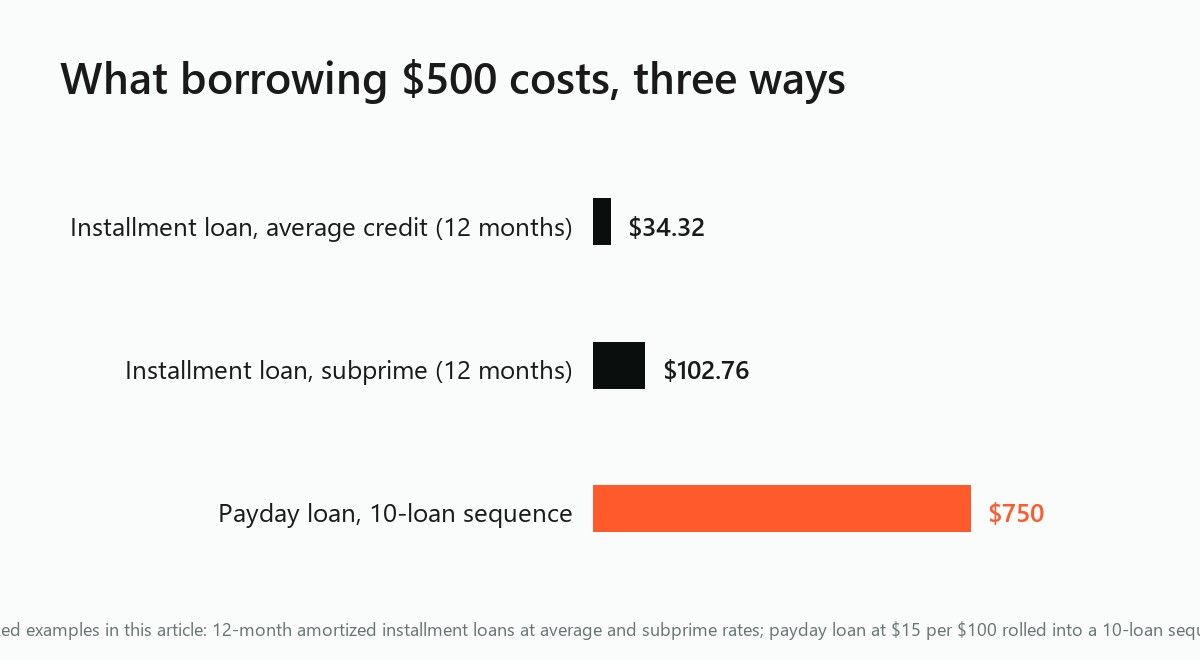
Average credit (around 700 FICO): 12.44% APR, 12-month term. Using the amortization formula above, your monthly payment comes to about $44.53. Over 12 months, that's a total of payments of about $534.32, meaning your total finance charge (what the loan actually costs you beyond the $500 you borrowed) is about $34.32.
Poor or subprime credit: 36% APR, 12-month term. Same $500, same 12-month term, but at the top of the subprime range. Your monthly payment rises to about $50.23. Total of payments comes to about $602.76, putting your total finance charge at about $102.76.
Now compare that to a $500 payday loan using the standard $15-per-$100 fee. A single, non-renewed two-week payday loan on $500 costs a flat $75 in fees, a fee structure that works out to a 391% APR once you annualize it. For the full breakdown of how a two-week fee translates into that APR, see this site's explainer on payday loan APR math. Seventy-five dollars on $500 sounds almost manageable next to a year of installment payments, until you factor in what actually happens to most payday borrowers.
According to CFPB data, more than 80% of payday loans are rolled over or followed by another loan within 14 days, and roughly half of all payday loan sequences run to 10 or more loans back to back. If that $500 loan runs to a 10-loan sequence (the original loan plus nine rollovers), each carrying a $75 fee with no principal paid down, total fees reach $750. That's 150% of the original $500 in fees alone, and the borrower still owes the full $500 principal at the end of it.
Set the three numbers next to each other and the picture is stark: about $34.32 in total finance charges for an average-credit installment loan, about $102.76 for a subprime installment loan, and $750 or more in fees alone for a payday loan that runs to a 10-loan sequence, the rollover pattern CFPB data shows is common, with the original debt still outstanding. The installment loan, at either credit tier, is paid off and gone at the end of its term. The rolled-over payday loan can leave you having paid more than your original loan amount in fees while still owing that same amount.
How On-Time Installment Payments Can Build Your Credit
There's a second advantage to the installment structure that doesn't show up in the finance-charge math: it can work in your favor on your credit report. An installment loan builds credit only if the lender reports it to at least one of the three nationwide bureaus, Equifax, Experian, and TransUnion, tracking your payment status as on time, late, or missed, according to the CFPB's guide to rebuilding credit. Not every lender reports to all three, so ask the lender which bureaus it reports to before you sign.
That reporting matters because payment history is the single largest factor in a FICO score, carrying 35% of the total weight, per myFICO's breakdown of score factors. Twelve months of on-time installment payments, reported faithfully, is a direct input into the score that determines what you'll be offered the next time you need to borrow.
Compare that to a payday loan. Most storefront and online payday lenders don't furnish payment data to the three nationwide bureaus. Instead, specialty consumer reporting agencies that collect payday-type data, such as Teletrack (which feeds Equifax), Clarity Services (which feeds Experian), and DataX (which feeds Equifax), are generally used for lender underwriting rather than mainstream score-building, per the CFPB's guide to specialty consumer reporting agencies.
This is a general pattern, not a rule that applies to every payday lender in every state, so don't assume any specific payday loan will or won't show up on your file. If you've already been through a payday default and you're working to rebuild, this site's 12-month roadmap for rebuilding credit after a payday default walks through that process step by step.
The Traps: Origination Fees and Add-On Insurance
An unsecured installment loan's lower total finance charge can get eaten alive by two things that don't always show up in the headline APR.
Origination fees. Bankrate's data on personal loan origination fees shows they typically run roughly 1% to 8% of the loan amount, and they're usually deducted straight from your disbursed proceeds rather than billed to you separately. Say you're approved for $1,200 with a 5% origination fee. You'll net $1,140 in hand, but you still owe, and pay interest on, the full $1,200.
Your purchasing power just shrank without the sticker-shown loan amount changing at all. One caveat worth flagging: under federal disclosure rules, an origination fee that counts as a finance charge is already folded into a lender's disclosed APR, so don't assume you can simply add a separate origination percentage on top of a quoted APR figure. Ask the lender directly whether the fee is already reflected in the number they gave you.
Add-on credit insurance. Optional insurance-like products, sometimes called credit life, credit disability, or "payment protection," get sold alongside the loan and promise to cover your payments if you die, become disabled, or lose your job. The premium is often calculated as a single up-front cost and then rolled directly into your loan principal, which quietly raises both your monthly payment and your total finance charge, per Experian's explainer on credit insurance.
The risk is real. In May 2023, the CFPB ordered OneMain Financial to pay $20 million over deceptive add-on product sales, after finding that staff had pre-packed optional insurance and protection products onto loan paperwork without clearly disclosing them, and made cancellation difficult. OneMain had to refund $10 million to roughly 25,000 consumers and extend its full-refund cancellation window from 30 to 60 days going forward, per the CFPB's OneMain consent order.
The National Consumer Law Center flagged these add-on products as prone to abuse in a 2015 report, recommending states restrict or prohibit bundling them into consumer loans. The OneMain case shows the concern is current.
Before you sign anything, ask the lender two direct questions: is there an origination fee, and is any insurance or "payment protection" product pre-checked or bundled into the paperwork? Both are usually optional or negotiable, and both push the real cost of the loan past what the headline APR or principal suggests. If a comparable-rate installment loan isn't available to you right now, this site's roundup of payday loan alternatives covers other options worth checking.
Your Next Step
If you're holding a payday loan offer and comparing it against an installment loan, don't stop at the APR on the page. Pull out both disclosure boxes, find the "total of payments" line on each, and subtract the amount financed from that number to get the real finance charge. That single figure, not the advertised rate, tells you what the loan actually costs you. Do that this week, before either loan is signed, and you'll be comparing the two offers on equal terms.
Frequently Asked Questions
What's the difference between a secured and an unsecured installment loan?
A secured installment loan requires collateral, like a car or savings account, that the lender can claim if you default. An unsecured installment loan requires no collateral, per the CFPB's definition of secured versus unsecured credit; the lender's only recourse on default is collections, credit-bureau reporting, and legal action.
Can I get an unsecured installment loan with poor credit?
Often, at a price. Kashable works with subprime and no-credit-file borrowers through employer-based repayment, and Avant publishes APRs up to 35.99%, per each lender's own published rate disclosures. Shopping multiple lenders, including credit unions, is worth doing before you accept an offer.
Does an unsecured installment loan build credit when a payday loan doesn't?
Only if the lender reports it. An installment loan builds credit when the lender furnishes it to the nationwide bureaus, since payment history is 35% of a FICO score per myFICO. Most payday lenders don't furnish to those bureaus, per CFPB guidance, so paying one off on time usually doesn't carry the same benefit.
What should I watch for on an installment loan offer besides the APR?
Check for an origination fee (typically 1% to 8% of the loan amount, deducted from your proceeds, per Bankrate's origination-fee data) and for any add-on insurance or "payment protection" product bundled into the paperwork. Both can raise your real cost beyond what the headline APR implies, so ask the lender to itemize each one.