




Virginia's payday loan laws cap short-term loan interest at 36% a year, add a capped monthly maintenance fee on top, limit the loan itself to $2,500, and set a term of four to 24 months. Only a lender licensed by the Virginia State Corporation Commission can make one, and that rule reaches online lenders with no office in the state at all. This is the Code of Virginia, Title 6.2, Chapter 18, the codification of the 2020 Fairness in Lending Act, and it took effect January 1, 2021.
The Commonwealth rewrote its small-loan rules in 2020, and older guides describe a payday loan market that no longer exists. What Pew describes as one of the more complete small-loan rewrites in the country replaced it, and the details matter more than the headline number. Unlike Texas, where a brokerage-fee loophole still lets some lenders sidestep a real rate cap, Virginia closed the equivalent gap outright.
What the Fairness in Lending Act Changed in 2020
Before 2020, Virginia ran separate statutes for payday loans, title loans, and open-end credit, each with its own loopholes. The Fairness in Lending Act (HB 789 and SB 421) folded all of it into one framework: Chapter 18 of Title 6.2, sometimes called the "short-term loan" chapter, now governs payday, title, installment, and open-end or fintech lenders under the same rate structure. Pew notes the law applies the same way to storefront and online loans, which is the part most state summaries leave out.
The change forced a real exit. Advance America, at the time Virginia's largest storefront payday chain, announced it would stop lending in the state rather than operate under the new 36% cap. Its chief legal officer said the rate restriction "eliminated lending options" because a lender "cannot accommodate both the higher loss rates that come with serving the needs of subprime consumers and basic operating expenses," Virginia Mercury reported. Read that quote from the other side of the counter and it says something useful: the old business model depended on fees the new law does not allow.
Virginia's 36% headline rate echoes a number federal law already uses: the Military Lending Act sets the same 36% ceiling for active-duty service members and their dependents. The two are not identical in how they are calculated. The federal rate folds fees into the number itself, while Virginia's 36% covers interest only, with the maintenance fee added on top, which is why the real cost of a Virginia loan runs well above 36% once fees are counted, as the worked example below shows.
The Current Rules: Rate, Fees, Amount, and Term
Chapter 18 runs from § 6.2-1800 through roughly § 6.2-1829, and four numbers from it do the real work for a borrower.
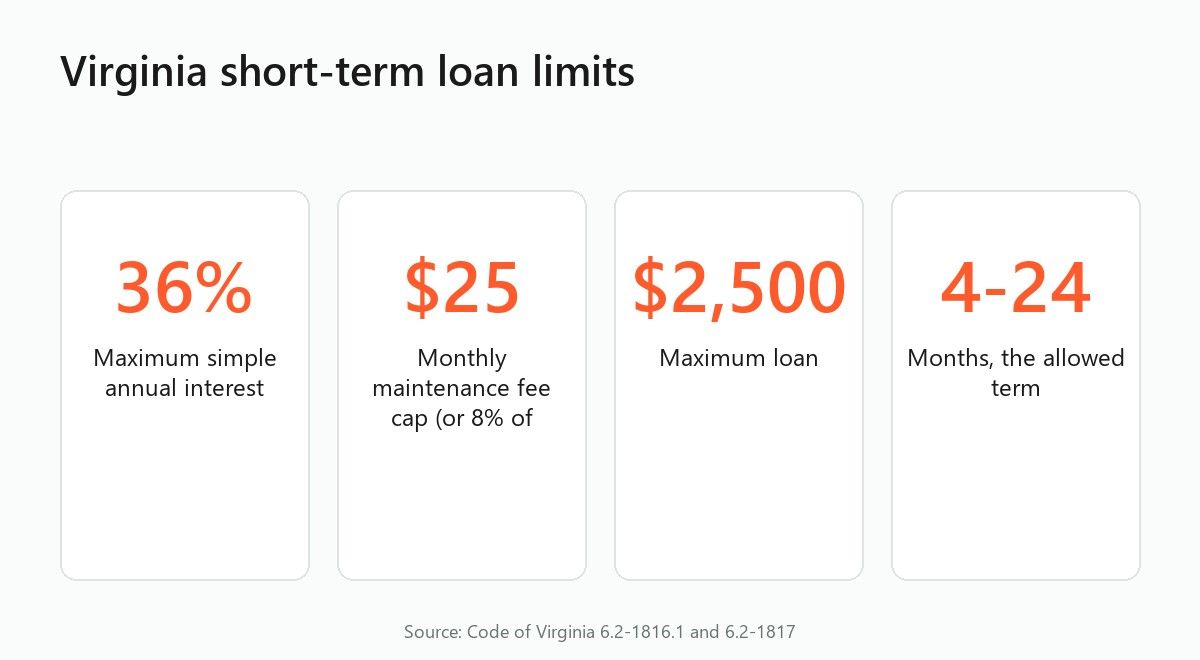
Interest: a simple annual rate that cannot exceed 36%. The exact text of § 6.2-1817(A) says "interest at a simple annual rate not to exceed 36 percent."
Maintenance fee: lenders may also charge a monthly maintenance fee that cannot exceed "the lesser of eight percent of the originally contracted loan amount or $25." The statute is specific that this fee does not get added to the balance interest accrues on, which keeps it from compounding the loan's cost the way a rolled-in fee would (§ 6.2-1817(B)). Other charges are capped too: a bounced-payment (deposit item) fee up to $25, a late charge up to $20, and collection damages and costs capped at the original loan amount.
Loan amount: "A licensee shall not cause any person to be obligated to the licensee in any capacity at any time in the principal amount of more than $2,500" (§ 6.2-1816). Section 6.2-1816.1 repeats the same figure.
Term: a minimum of four months and a maximum of 24 months (§ 6.2-1816.1). That minimum can be shortened only if the loan's monthly payment stays at or below the greater of two thresholds: 5% of the borrower's verified gross monthly income, or 6% of the borrower's verified net monthly income. Notice what that test actually governs. It is a condition a lender must meet before offering you anything shorter than the standard four-month minimum, not a ceiling on how much you can borrow.
Two more protections sit inside the same section. Every loan has to be a "precomputed loan" repaid in substantially equal installments of principal, fees, and interest combined, so a lender cannot structure it as one large balloon payment at the end. That protects against the classic payday-loan trap: a single lump-sum payment due in full on the borrower's next payday, which forces many people to renew or take out a second loan just to cover it.
You can also cancel the loan without cost any time before 5 p.m. on the third business day after you take it out, which gives you a real window to back out if the numbers do not sit right once you get home.
Virginia backs this up with implementing regulations. Under § 6.2-1815, the SCC adopts operating rules for licensees, codified as 10VAC5-200 (Short-Term Lending) in the Virginia Administrative Code, and 10VAC5-200-80 spells out the required language for a consumer-disclosure pamphlet every borrower must receive before signing. That pamphlet is meant to put the interest rate, the fee structure, and the total cost in plain language before you commit to anything.
What a Loan Actually Costs Today
The 36% figure is the interest rate, not the real annualized cost. The maintenance fee stacks on top of it, and once you run the math, the real annualized cost is closer to double the headline number. That gap between the advertised rate and the real cost is exactly where borrowers in every state get surprised, and Virginia's statute makes it checkable in a way older payday laws never did. Here is the arithmetic on a $1,000 loan with a six-month term, near the short end of Virginia's four-to-24-month window.
Interest: $1,000 x 0.36 x (6/12) = $180.00.
Maintenance fee: the lesser of $80 (8% of $1,000) or $25 a month works out to $25, charged monthly for six months, for $150.00 total.
Add them together and you get $330.00 in interest and fees on a $1,000 loan over six months. That is 33% of the principal in half a year, which annualizes to roughly 66% effective cost ([$330 / $1,000] divided by [6/12] equals 66%). Sixty-six percent is a real cost, well above the 36% a borrower might assume from the headline cap alone.
It is also far below what uncapped states allow. Small-dollar borrowing in Virginia still costs real money, yet the law makes the true cost knowable before you sign, and for a borrower deciding whether to take the loan at all, that is worth more than a marketing headline. Ohio took a similar approach with its own 2018 reform, House Bill 123: fold every fee into one capped formula so the total cost is knowable up front, per Ohio's Legislative Service Commission.
The Online Lender Rule: Licensing Reaches Past Virginia's Borders
This is the detail most competitor guides skip, and it is the one that matters most if you are looking at an internet lender's ad rather than a storefront. Section 6.2-1801 requires a license to make loans to Virginia residents "whether or not the person has a location in the Commonwealth." The same section separately bars unlicensed brokering or arranging of short-term loans for a Virginia resident, again "whether or not the person has an office or conducts business at a location in the Commonwealth."
In plain terms: an out-of-state or offshore website advertising fast cash to Virginia residents needs the same SCC license as a payday store on a strip mall in Richmond. There is no carve-out for being purely digital.
The statute voids the loan outright when a lender skips that license: "Any loan made in violation of this section is void, and no person shall have the right to collect, receive, or retain any principal, interest, fees, or other charges" (same section, § 6.2-1801). If a lender was never licensed, you may not owe the debt at all, and that includes the fees and the interest, not just the amount above what a licensed lender could have charged. Steven Krieger Law, a Virginia consumer attorney, notes that unlicensed lending is also a misdemeanor.
Before you accept money from any online lender claiming to serve Virginia residents, check whether it actually holds a license. The SCC's Bureau of Financial Institutions maintains a licensee lookup, and a lender that cannot be found there is not operating legally in the state, regardless of how professional its website looks.
Consumer advocates say this confusion is common. The Virginia Poverty Law Center and legal-aid groups report that borrowers regularly are not sure whether an online lender advertising to Virginia residents actually holds a license, which is exactly the question the SCC's registry answers in a few minutes.
What the Market Looks Like Since 2021
The clearest evidence of how much the Fairness in Lending Act changed the state's lending landscape is who left. Advance America's exit was a major retreat, not a quiet trim to one product line: the state's largest storefront payday chain walked away from Virginia entirely because the new rate and fee structure did not support its old model, as Virginia Mercury reported. Pew frames the broader shift the same way: the Act moved payday, title, installment, and online lenders all onto one uniform structure. The SCC's Bureau of Financial Institutions publishes annual reports on licensed lenders in the state, and it examines those licensees directly under § 6.2-1813, the same oversight authority that backs the license requirement in the first place.
How to Verify a Lender and File a Complaint
The Virginia State Corporation Commission's Bureau of Financial Institutions licenses every short-term lender operating in the state under Chapter 18, examines them under § 6.2-1813, and takes consumer complaints directly. If you think a lender charged more than the statute allows or was never licensed, file with the SCC's Bureau of Financial Institutions.
Three checks are worth doing before you borrow, and one afterward if something feels wrong. Before signing, confirm the lender's license number against the SCC's own registry, ask for the disclosure pamphlet Virginia regulations require every licensee to hand over, and run the math yourself the way this article did above, using the 36% interest plus the lesser-of-8%-or-$25 monthly fee, so you know the real total before you owe it.
After the fact, if a Virginia-licensed lender broke one of these rules, or an unlicensed one collected on a loan the statute says should be void, file with the SCC's Bureau of Financial Institutions. You can also file a federal complaint with the CFPB when the lender operates across state lines.
Frequently Asked Questions
Is payday lending legal in Virginia?
Yes, but not in the form most people picture from other states. Short-term loans are legal only from lenders licensed by the Virginia SCC under Chapter 18, and every loan is capped at 36% simple annual interest plus a monthly maintenance fee of the lesser of 8% of the loan amount or $25 (Code of Virginia § 6.2-1817).
What's the maximum interest rate on a Virginia short-term loan?
36% simple annual interest, set by § 6.2-1817(A). That figure does not include the maintenance fee, so the real annualized cost of a loan runs higher once you add it in, roughly 66% on a $1,000, six-month loan once the $25 monthly fee is added.
How much can I borrow and for how long?
Up to $2,500 in principal, under §§ 6.2-1816 and 6.2-1816.1, repaid over a minimum of four months and a maximum of 24 months. A lender can offer a shorter term only if your monthly payment stays within a specific income-based threshold: 5% of verified gross monthly income or 6% of verified net monthly income, whichever is greater. That threshold controls the term length, not how much you can borrow.
Is an online payday loan to a Virginia resident legal?
Only if the lender holds an SCC license, and that requirement applies "whether or not the person has a location in the Commonwealth" (§ 6.2-1801). A loan made by an unlicensed lender, online or otherwise, is void under the same section, meaning the lender has no right to collect principal, interest, or fees on it.
Can I cancel a short-term loan after I sign for it?
Yes. Section 6.2-1816.1 gives you until 5 p.m. on the third business day after taking out the loan to cancel it without cost. That is a real window to reverse course if the terms do not look right once you review them at home.
Where do I check if a lender is actually licensed?
The Virginia State Corporation Commission's Bureau of Financial Institutions maintains the licensee registry and takes consumer complaints against short-term lenders operating under Chapter 18. That is also where to report a lender you believe is operating without a license or charging above the statutory caps. A licensed lender doing business with you also has to hand over a disclosure pamphlet under 10VAC5-200-80, spelling out the rate, fees, and total cost before you sign.