




Before you trust any payday loan calculator, online or otherwise, you need to know three things: the loan amount, the fee charged per $100 borrowed, and the term in days. Plug those three numbers into the same formula a calculator uses, and you can verify its output with a pocket calculator. That matters because a payday loan calculator is only as honest as the assumptions baked into it, and some of those assumptions are easy to get wrong if you don't know what to look for.
You've got a car repair, a utility shutoff notice, or a paycheck that's still four days out. The last thing you need on top of that is a calculator that rounds in the lender's favor.
Most calculators you'll find online, whether they belong to a lender or a comparison site, will hand you a single APR figure and stop there. They don't show their work, and they rarely explain which fee convention they used to get there. That's a problem on a loan this expensive, because a hidden assumption can shift the number by dozens of percentage points without you ever knowing which way it moved. Walking through the formula yourself, once, means you'll never have to take a calculator's word for it again.
The Three Inputs Every Calculator Needs
Every payday loan APR calculation starts with the same three pieces of information. Miss one, and the output is guesswork.
- Loan amount. This sounds simple, but it isn't always the number you think it is. Some states charge the fee on top of what you receive (the "face value" of the loan). Others deduct the fee from the check before you ever see the cash, which means the amount you actually have to spend is smaller than the loan's stated size. More on that in the next section, because it changes every number downstream.
- Fee per $100 borrowed. Payday lenders don't usually quote interest rates. They quote a flat fee, often expressed as dollars per $100. A $15-per-$100 fee sounds modest. It isn't, once you run it through the APR formula below.
- Term in days. Payday loans are short; Florida, for example, allows terms from 7 to 31 days, and the term is what turns a flat fee into an annualized rate. It's the reason a two-week loan can carry an APR north of 300 percent even though the dollar fee looks small on its own.
Once you have all three, you're ready for the formula. But there's a wrinkle to settle first, and it's the one most online calculators skip past.
The Fee Formula: Face-Value vs. Amount-Financed
The fee itself is straightforward: fee equals the fee rate multiplied by the loan amount. What's not straightforward is which "loan amount" you're supposed to use, and this single choice can swing your APR by dozens of percentage points, as much as 69 points on California's $300 loan below.
There are two conventions in use across the country, and neither one is a federal standard. Federal law (the Truth in Lending Act, enforced through Regulation Z at 12 CFR 1026.18) requires every lender to disclose an APR in the loan's paperwork, but it doesn't dictate whether states structure their fees on the face amount or the amount actually financed. That's left to individual states and, in practice, to individual lenders.
- Face-value method. The fee is added on top of what you receive. You get the full loan amount in cash, and you repay that amount plus the fee. Washington uses this approach: borrow $300, receive $300, and owe $345 when the loan is due.
- Amount-financed method. The fee is subtracted from the check before you get it. California uses this approach: a $300 check nets you only $255 in cash after the $45 fee is deducted, but you still owe the full $300 face amount at repayment. Because you only had $255 to spend, the honest APR calculation uses $255 as the "amount financed," not $300 (California Department of Financial Protection and Innovation).
Same $45 fee. Same two-week term. Two different APRs, depending on which number sits in the denominator. That's the piece most online calculators leave out, since they show a single APR with no work behind it, and it's exactly why doing the math yourself matters.
The APR Formula, Worked Step by Step
The formula itself: APR equals the fee divided by the loan amount, multiplied by 365 divided by the term in days, multiplied by 100. For the full breakdown of what APR means and why it's the number regulators require lenders to disclose, our payday loan APR explained guide covers the concept in depth. Here, we're focused on running the numbers with your own calculator.
Take California's $300 check with a $45 fee, due in 14 days, and work it both ways.
Face-value method (using the $300 check amount): divide $45 by $300, which gives you 0.15. Multiply that by 365 divided by 14, which is 26.071. Multiply the result by 100. That's 0.15 times 26.071 times 100, which comes out to 391.1% APR.
Amount-financed method (using the $255 actually disbursed): divide $45 by $255, which gives you 0.1765. Multiply that by 26.071. Multiply by 100. That's 0.1765 times 26.071 times 100, which comes out to 460.1% APR.
Same loan, same fee, same due date, and a 69-point gap between the two figures. California's own regulator describes typical payday loan APRs there as "more than 400 percent," which lines up with the amount-financed number, not the naive face-value one. That gap comes from which denominator a calculator chose to use, and now you know how to check which one it picked.
A Payday Loan Example, State by State
Here's a payday loan example run across four states, each recomputed independently with a 14-day term so the figures line up on equal footing. The fee structure and which convention applies differ by state, which is why the nominal rate and the fee convention together decide what APR you actually pay.
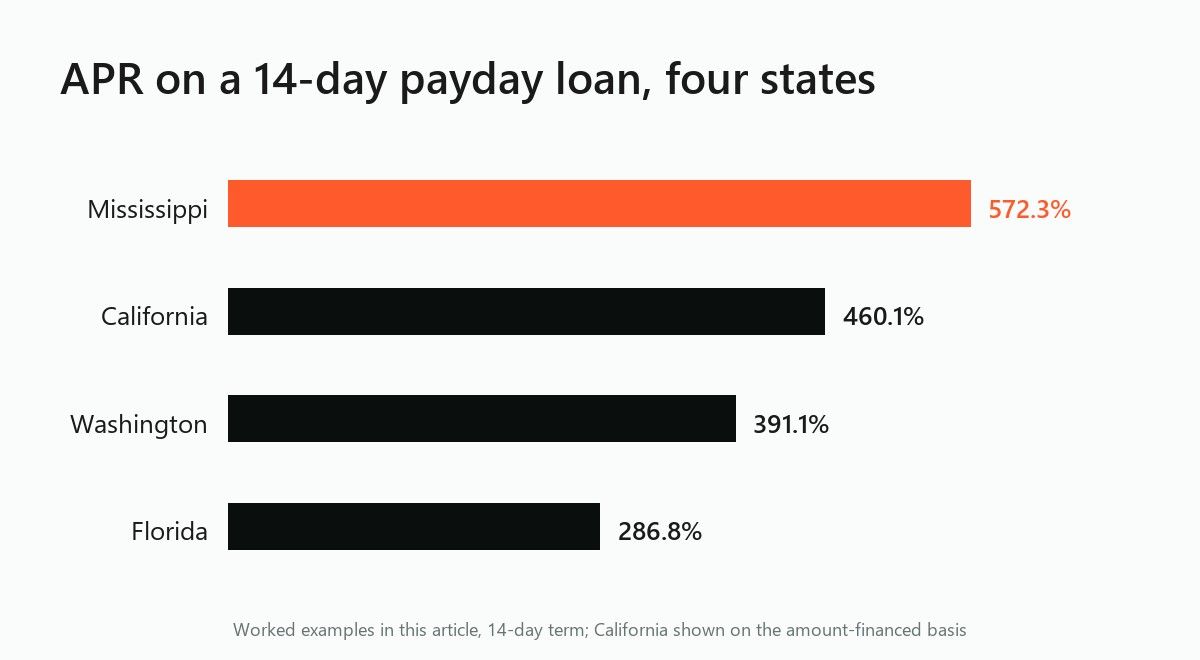
| State | Loan Amount | Fee | Term | APR |
|---|---|---|---|---|
| California | $300 (nets $255 cash) | $45 | 14 days | 391.1% face-value / 460.1% amount-financed |
| Florida | $500 | $55 total ($50 fee + $5 verification) | 14 days | 286.8% |
| Mississippi | $500 check (nets $410 cash) | $90 | 14 days | 572.3% |
| Washington | $300 | $45 | 14 days | 391.1% |
Florida's fee is charged on top of the $500 disbursed, not deducted from it: a $50 fee (10% of the loan) plus a separate $5 verification fee under state statute, for $55 total (Florida Statute § 560.404, § 560.309). That fee is fixed regardless of term, but Florida law allows a term as short as 7 days or as long as 31, so the same $55 fee produces very different APRs depending on when the loan is due. Fourteen days is used here so every state in the table sits on equal footing.
Mississippi, like California, deducts the fee from the check before you get it: a $500 check nets $410 in cash after the $90 fee is applied, which works out to the state's $21.95-per-$100 tier for checks in that range, detailed in our Mississippi payday loan law guide. Washington's fee tiers, detailed in our Washington payday loan law guide and set under RCW 31.45.073, cap the fee at $15 per $100 for loans up to $500, charged on top of the amount you receive. That's the same face-value convention as California's naive calculation, which is exactly why the two states produce an identical 391.1% at the same loan size and term.
Ohio and Texas don't fit this table, and forcing them in would misrepresent how those states actually work. Ohio's Short-Term Loan Act (Ohio Revised Code 1321.39 and 1321.40) doesn't use a flat fee-per-$100 structure at all: it caps the interest rate at 28% APR and adds a separate monthly maintenance fee, a structure our Ohio payday loan law guide explains in full. That combination produces a total cost far below a typical storefront payday loan, which is the reform's entire point.
Texas takes the opposite path. The state sets no statutory fee cap for storefront lenders, because its Credit Access Business structure lets a broker add an uncapped fee on top of a third-party lender's loan, and our Texas payday loan law guide walks through how that loophole produces real-world APRs of 365% to 496%, according to the Texas Office of Consumer Credit Commissioner's 2025 study, a wide range with no clean $/100 figure the reader could check by hand. Neither state reduces to a single number you can drop into a standard calculator, which is exactly why they're worth reading about on their own.
Now that you've seen what these loans actually cost when the math is done in full, it's worth knowing what else is available before you sign anything. Our guide to payday loan alternatives walks through options that don't carry a triple-digit APR, including credit union payday alternative loans.
How Rollovers Stack the Real Cost
The APR formula tells you the annualized rate for a single loan cycle. It does not tell you what happens if you can't pay the loan off on the original due date and instead pay just the fee to push the due date back, a move commonly called a rollover or renewal. That's where the dollar cost starts climbing even though the APR on paper never changes.
Take a $300 payday loan with a $45 fee due every 14 days. Suppose you pay only the fee at each due date, rolling the loan forward three times before finally paying it off in full on the fourth cycle. Here's what that costs in fees alone, cycle by cycle.
- Cycle 1: $45 fee paid, loan rolled forward.
- Cycle 2: another $45 fee paid, loan rolled forward again.
- Cycle 3: another $45 fee paid, loan rolled forward a third time.
- Cycle 4: final $45 fee paid along with the $300 principal, loan closed out.
Total fees across four cycles: 4 times $45, which equals $180. That's 60% of the original $300 principal, paid in fees alone, over eight weeks, to borrow the same $300 the entire time. The APR stayed at roughly 391 to 460 percent every single cycle, because APR measures a per-cycle rate, not a cumulative one. What changed is the number you actually felt leaving your bank account: the same loan, four times the fee.
This pattern isn't rare. The Consumer Financial Protection Bureau's own analysis of more than 12 million storefront loans found that over 80% of payday loans are rolled over or followed by another loan within 14 days, and 15% of new loan sequences run to 10 or more loans before they're finally paid off (CFPB, Payday Lending Data Point, March 2014). If you're already a cycle or two into a rollover, our guide to breaking the payday loan rollover cycle lays out a concrete way to stop the fee from repeating a fifth time.
Putting the Formula to Work
You now have everything a calculator has: the three inputs, the fee formula, and the APR formula, worked by hand twice on a real example. The next time you see a payday loan calculator, or a lender's disclosure box, run the same numbers yourself. Confirm whether the state uses the face-value or amount-financed convention.
If two calculators disagree on the same fee, check which denominator each one used. A calculator that skips that distinction gives you an incomplete answer, and on a decision this expensive, that isn't good enough.
Frequently Asked Questions
What three numbers do I need before I can check a payday loan calculator?
The loan amount (face value or amount financed), the flat fee per $100 borrowed, and the term in days. The amount sets the denominator, the fee sets the numerator, and the term turns a flat fee into an annualized rate. With those three, you can confirm any calculator's output yourself.
Why do two calculators show different APRs for the same fee?
One common cause is that one calculator uses the face-value loan amount (what you receive), and the other uses the amount actually financed (what's left after the fee is deducted). California's regulator uses the amount-financed convention, which is why it describes typical APRs as "more than 400 percent" rather than the 391.1% a face-value calculation gives on the same loan.
Does the APR change if I roll over my payday loan?
No. The APR is a per-cycle rate and stays roughly the same each time you renew, but the total dollar amount of fees you pay climbs with every rollover. A $300 payday loan rolled three times before payoff costs $180 in fees total, four times the fee of a single cycle, even though the APR reads the same each time.
Why don't Ohio and Texas payday loans fit the standard APR formula?
Neither state uses a flat fee-per-$100 structure. Ohio's Short-Term Loan Act caps interest at 28% APR plus a separate monthly maintenance fee instead of a per-$100 fee. Texas sets no statutory fee cap for storefront lenders, relying on a Credit Access Business structure where a broker adds its own fee on top of a third-party lender's loan.
Is the APR formula the same one required by federal law?
The formula reflects the annualized cost concept that Regulation Z (12 CFR 1026.18), under the Truth in Lending Act, requires lenders to disclose in every loan's paperwork. Federal law requires the disclosure; it does not dictate whether a state's fee structure is calculated on the face value or the amount financed, which remains a state-by-state and lender-by-lender distinction.