



North Carolina payday loan laws have banned the practice since August 31, 2001. North Carolina let the law that authorized payday lending expire and never brought it back, rather than capping rates into unprofitability the way some states did.
That single fact, a sunset clause the legislature simply declined to renew, makes North Carolina one of the cleanest payday-loan bans in the country, and it explains why online and "tribal" lenders keep showing up in North Carolina inboxes anyway, years after the storefronts disappeared.
If you're reading this because a text message or a pop-up ad approved you for a loan from a company that describes itself as a tribal or out-of-state business, and you're wondering whether that loan is even real under North Carolina law, here's where North Carolina stands: its courts and Attorney General have treated these loans as subject to North Carolina law despite tribal-affiliation claims, but whether your specific loan is enforceable depends on facts only a legal aid review can sort out.
The Statute That Ended Payday Lending in North Carolina
In 1997, the North Carolina General Assembly passed the Check Cashing Act, codified at North Carolina General Statute § 53-281, which authorized deferred-deposit lending, the payday loan structure where a borrower writes a postdated check and the lender holds it until payday. The law carried a sunset clause built into the statute itself. Lawmakers gave the industry four years, and when August 31, 2001 arrived, the legislature let the authorization lapse rather than renew it.
That detail matters more than it sounds like it should. North Carolina simply stopped granting the license that made payday loans legal in the first place, rather than passing a new law declaring them illegal outright.
Without that license, payday lending in North Carolina falls back under the state's general usury and consumer finance statutes, both of which cap rates far below what a payday loan needs to turn a profit. North Carolina is generally credited as the first state to end payday lending this way, through non-renewal rather than a new prohibition statute.
Once the authorization lapsed, there was no separate legal category for payday loans anymore. Any lender making a short-term, high-fee loan to a North Carolina resident now has to answer to the same rate caps that govern every other consumer loan in the state.
The Rate Caps That Back Up the Ban
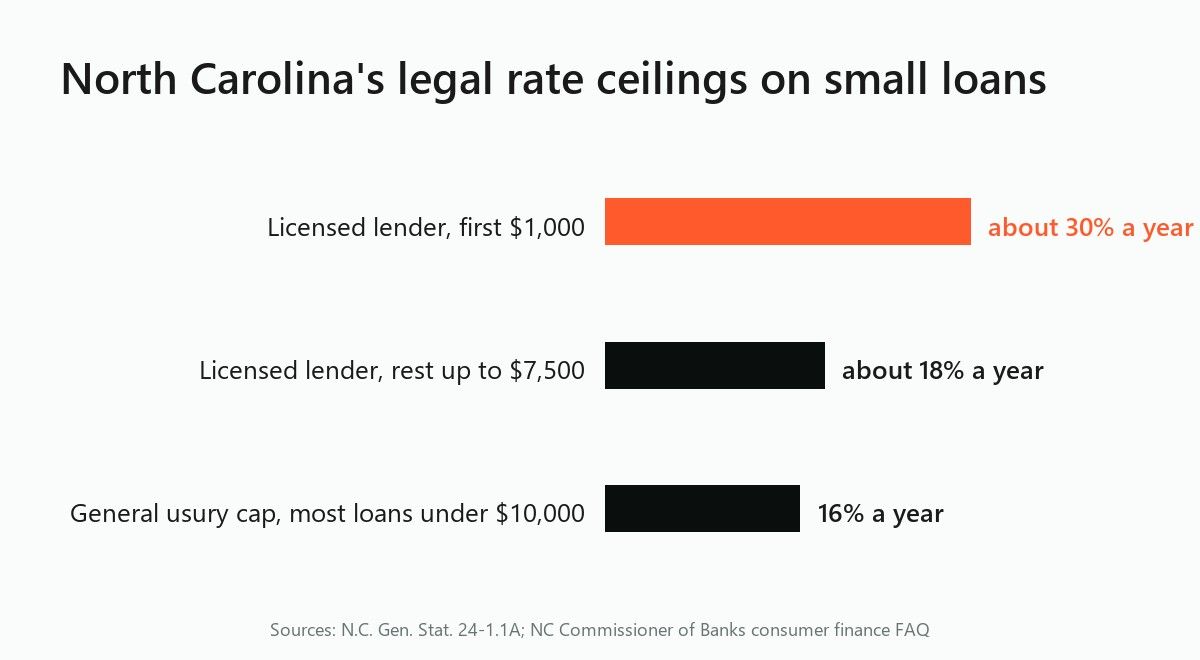
North Carolina's ban only holds because the state's general usury law makes payday-style pricing mathematically impossible for an unlicensed lender. Under North Carolina General Statute § 24-1.1A, the general usury cap is 16% per year on most non-real-estate loans under $10,000 made by a lender who doesn't hold a specific exemption or license.
Payday pricing runs far above anything a 16% annual ceiling allows. So even without a statute that says "payday loans are banned" in so many words, the general usury cap does the job. A payday lender operating without a license in North Carolina violates the same interest-rate law that applies to a personal loan from a stranger on the street.
This is also the reason North Carolina payday loan laws read differently from how New York's ban works, which blocks payday lending through licensing requirements paired with criminal usury statutes rather than a sunset clause. Both states end up in the same place, no legal payday lending, but they get there by different legal roads, and the enforcement tools each state's regulators reach for reflect that difference.
North Carolina's approach removes the payday-lending license category entirely rather than capping the rate a licensed payday lender could charge. There's no rate a payday-style lender could charge and stay within North Carolina law short of getting licensed as a Consumer Finance Act lender and following that Act's own tiered rate structure instead.
What Happened to the Storefronts
Before 2001, North Carolina had a visible payday lending industry: storefronts in strip malls, check-cashing counters, the whole familiar setup you'd have seen in states that still allow it today. After the sunset clause took effect, that storefront payday industry left the state rather than restructure under a rate cap it couldn't operate within.
I'm not going to hand you a specific count of locations closed or jobs lost. There's no verified count to give you here, and a number without a source is worse than no number at all. What's documented is the outcome: licensed, storefront payday lending as a business model stopped operating openly in North Carolina once the Check Cashing Act's authorization expired.
The Current Threat: Online and Tribal Lenders
A storefront needs a physical address and a state license to operate. A website doesn't, at least not in the eyes of a lender trying to dodge one, and why online lenders cost more than their storefront predecessors is a separate problem layered on top of this one. That's the loophole North Carolina has spent the last two decades fighting, and it's the reason this topic still matters today. The marketing tactics behind these offers, unsolicited texts, approval before any application, pressure to move fast, follow patterns common to online lending and tribal lending traps more broadly, not just tribal-affiliation claims specifically.
The most direct proof North Carolina takes this seriously is the Western Sky/CashCall case. The North Carolina Attorney General's office sued Western Sky Financial, CashCall Inc., WS Funding LLC, and Delbert Services Corp. in 2013, alleging the companies made loans to North Carolina consumers while claiming tribal-affiliation immunity from the state's usury law.
That case is the state's clearest precedent that a tribal-affiliation label doesn't automatically shield a lender from North Carolina law when the loan actually goes to, and gets collected from, a North Carolina resident.
The Attorney General's office has kept pressing on this front. On August 20, 2020, Attorney General Josh Stein joined attorneys general from California, Illinois, New York, Massachusetts, Minnesota, New Jersey, and D.C. in suing to block an FDIC rule that the states argued would let payday, auto-title, and installment lenders evade state rate caps by routing loans through out-of-state banks, a workaround commonly called "rent-a-bank" lending, according to the North Carolina Department of Justice's press release on the suit.
That suit is about preserving exactly the kind of usury protection North Carolina General Statute § 24-1.1A gives North Carolina residents, and it tells you the state doesn't treat online workarounds as somebody else's problem.
Is a Tribal or Online Loan to a North Carolina Resident Enforceable?
If you got approved by an online lender that says it's a tribal business, and you're wondering whether you actually have to pay it back, I understand the instinct to want a flat yes-or-no answer. I can't give you one, and neither can any honest source.
Courts, including in the Western Sky litigation, have generally held that a loan agreement's choice-of-law clause or claimed tribal-sovereign-immunity provision does not override the consumer-protection law of the state where the borrower actually lives and signed, when the loan is effectively made to and collected from a resident of that state. That's a meaningful protection, and it's the legal theory North Carolina relied on to pursue the Western Sky case.
But this is a contested area nationally, and outcomes vary by lender structure, loan documentation, and the specific facts of how the loan was made. If you have an actual, current loan from an online or tribal lender and you're being asked to keep paying on it, don't try to resolve that yourself based on a general rule you read on a website, including this one.
File through the AG's consumer complaint portal or contact a legal aid office before you decide the debt is or isn't valid. It beats guessing.
Legal Small-Loan Options Under the NC Consumer Finance Act
North Carolina residents who need a small loan still have a licensed, legal path: the North Carolina Consumer Finance Act, codified at Chapter 53, Article 15. Licensed consumer finance lenders can charge tiered rates that run higher than the general 16% usury cap, but they're bound to specific, published tiers rather than open-ended payday pricing.
According to the North Carolina Commissioner of Banks' own Consumer Finance FAQ, licensed lenders may charge roughly 30% on the first $1,000 of unpaid principal and 18% on the remainder of loans up to $7,500, with the rate stepping down further on larger balances. These lenders must hold an active license from the Commissioner of Banks, which requires a $500 application fee and a minimum annual assessment of $1,000, according to the same NCCOB source.
Before you borrow from any lender claiming to operate under the Consumer Finance Act, verify the license directly with NCCOB rather than taking the lender's word for it. The Commissioner of Banks maintains a licensee lookup, and a legitimate CFA lender will be listed in the Commissioner's records. That's the direct way to tell a compliant lender from an unlicensed one borrowing the Act's name for credibility. A lender that resists giving you its license number, or claims it doesn't need one because it's "tribal" or based out of state, is telling you something important about how it expects to be treated if you complain.
Federal credit unions offer another legal small-dollar route: Payday Alternative Loans, known as PALs. Under the National Credit Union Administration's own rule, PALs I loans run from $200 to $1,000 with one- to six-month terms and an application fee capped at $20, available after one month of credit union membership.
PALs II loans go up to $2,000 with terms of one to 12 months and are available immediately upon joining a credit union, per the NCUA's 2019 rule announcement. If you're a North Carolina resident eligible to join a federal credit union, a credit union PAL loan comes with a capped application fee, fixed terms, and none of the enforceability questions an online or tribal-affiliated loan raises.
How to Report an Illegal Lender in North Carolina
North Carolina gives you two regulators to go to, and you don't have to choose just one.
The North Carolina Commissioner of Banks licenses and examines Consumer Finance Act lenders and accepts complaints against both licensed and unlicensed lenders operating in the state. If a lender is charging you rates that look like payday pricing, or claiming a license it doesn't actually hold, NCCOB is the office that accepts a complaint about it.
The North Carolina Attorney General's office enforces the state's usury and unfair-and-deceptive-practices laws, and it's the office that pursued the Western Sky/CashCall case against tribal-affiliated lenders. You can file a consumer complaint directly through the AG's online consumer complaint portal.
When you file, include the lender's name, website or contact information, the amount you were charged or asked to pay, and any documentation of the loan terms you have. Screenshots of the lender's website, text messages, and the original loan agreement all strengthen a complaint.
If the lender operates entirely online and you can't tell where it's actually based, file with both state offices anyway, and consider filing a federal complaint with the Consumer Financial Protection Bureau as well. The CFPB accepts complaints about lending practices nationwide, which matters when a lender is structured to look like it operates outside any single state's reach. The Attorney General's office has already shown it will pursue out-of-state and tribal-affiliated lenders through the courts when the facts support it.
Frequently Asked Questions
Are payday loans legal in North Carolina?
No. North Carolina's Check Cashing Act, North Carolina General Statute § 53-281, authorized payday-style lending under a sunset clause, and the legislature let that authorization expire on August 31, 2001. Payday lending now falls under North Carolina's 16% general usury cap (North Carolina General Statute § 24-1.1A), a rate no payday loan can operate within.
What is the maximum interest rate a lender can charge in North Carolina?
Unlicensed lenders are capped at 16% annually on most loans under $10,000 under North Carolina General Statute § 24-1.1A. Licensed Consumer Finance Act lenders can charge higher tiered rates, roughly 30% on the first $1,000 and 18% on the remainder up to $7,500, per the NC Commissioner of Banks.
Can a tribal lender legally collect a payday loan from a North Carolina resident?
This remains a contested area nationally. Courts, including in North Carolina's Western Sky/CashCall case, have generally ruled that a claimed tribal-sovereign-immunity or choice-of-law clause doesn't override the consumer-protection law of the state where the borrower lives. If you have a live loan, talk to a legal aid attorney or contact the NC Attorney General's office rather than assuming either way.
What happened to payday lenders in North Carolina after the ban?
The storefront payday industry left the state after the Check Cashing Act's authorization expired in 2001. There's no verified count to give you here on locations closed or jobs affected, so treat any specific figure you see elsewhere with caution.
Where do I report an illegal payday lender in North Carolina?
File with the North Carolina Commissioner of Banks, which licenses Consumer Finance Act lenders and accepts complaints about unlicensed lending, and separately with the NC Attorney General's consumer complaint portal. The AG's office has pursued tribal-affiliated lenders targeting NC residents through the courts, including the Western Sky/CashCall case.