




You pay off a payday loan in one shot on your next payday. No monthly bill, no minimum payment, no card you can swipe again next week. So is a payday loan installment or revolving? Neither label fits, and federal lending law says why.
Under Regulation Z, the rule that implements the Truth in Lending Act, a payday loan is closed-end credit. That's a specific legal category with its own definition, and it explains something a lot of borrowers only discover after the fact: why the loan itself usually never shows up on a credit report at all.
The Short Answer: Closed-End Credit, by Definition
Regulation Z splits all consumer credit into two buckets, and there's no third option. Under 12 CFR 1026.2(a)(10), "closed-end credit means consumer credit other than open-end credit." Open-end credit, in turn, is defined by three specific conditions under 12 CFR 1026.2(a)(20): the lender expects repeat transactions, a finance charge can be applied to an outstanding balance over time, and the credit line replenishes as you pay it down (Cornell Legal Information Institute).
A payday loan checks none of those three boxes. You get a single advance. You pay a single fixed fee. There's no credit limit that opens back up as you repay, because there's nothing to repay in installments, you repay the whole thing at once.
Since it fails every test for open-end credit, it falls into the other bucket by default: closed-end. It's the plain text of the regulation that governs how every consumer loan in the country gets disclosed.
Walk through an example to see the test applied. Say you borrow $300 with a $45 flat fee, due in full in two weeks. Does the lender expect you to draw funds repeatedly against that same account? No, the transaction is one and done.
Can a finance charge accrue on a revolving balance over time? No, the $45 fee is fixed at origination, not recalculated monthly. Does your $300 limit reopen once you repay it? No, repaying it closes the loan out entirely rather than freeing up room to borrow again.
Three no answers, zero open-end conditions met, so the loan lands in the closed-end category by default. Run the same three questions against a mortgage or an auto loan and you'll get the same three no answers, which is why those products sit in the closed-end bucket too, just with a longer repayment schedule than a payday loan's single payment.
Closed-End vs. Open-End: What the Difference Actually Looks Like
The terms "installment" and "revolving" are the everyday names people use for these two legal categories, and seeing them side by side makes the distinction concrete.
- Payday loan (closed-end, single-payment): You borrow a fixed amount, pay one fixed fee, and repay the full balance in a single payment on your next payday. No repeat draws, no replenishing limit.
- Personal installment loan (also closed-end, but multi-payment): You borrow a fixed amount once, then repay it in a series of scheduled payments over months or years, each one chipping away at principal and interest. Auto loans and most personal loans work this way. It's closed-end because the amount is set at origination and doesn't reopen, but it's not a single payment like a payday loan.
- Credit card (open-end, revolving): You get a credit limit you can draw against repeatedly. Pay down what you owe and that room becomes available again. A finance charge can apply to whatever balance carries month to month. This is the textbook example of open-end, revolving credit under Regulation Z.
So a payday loan and a personal installment loan are actually cousins under the law, both closed-end, both a single advance of a fixed amount. Where they part ways is repayment structure: one payment versus several. A credit card lives in an entirely different legal category because the line refills as you pay it off.
If you're looking for other closed-end credit examples beyond payday loans, think mortgages and auto loans: any product where you borrow a set amount once and pay it back on a fixed schedule. For the full sequence from application to repayment, here's how the loan itself is structured.
Is a Payday Loan Variable or Fixed Rate?
Fixed. A payday loan's cost is a flat dollar fee tied to how much you borrow, something like $15 per $100, disclosed to you upfront before you sign anything. That fee doesn't float with an index the way a variable-rate credit card or line of credit sometimes can. It's set the moment you take out the loan and it stays that number.
Lenders still have to express that flat fee as an APR under the Truth in Lending Act, and that's why a two-week loan can show a number that looks alarming compared to a credit card's rate. If you want the full math on how that flat fee becomes a 391% APR, this breakdown covers the conversion step by step.
Does a Payday Loan Show Up on Your Credit Report?
Usually not, and this is the part that surprises most borrowers. The Consumer Financial Protection Bureau states it plainly: "Payday loans are generally not reported to the three major national credit reporting companies, so they are unlikely to impact your credit scores or help you build credit". Those three companies, Equifax, Experian, and TransUnion, are the ones whose files feed your FICO or VantageScore. If a lender doesn't send your payment history to them, that history simply isn't part of the calculation, good or bad.
Part of why this surprises people is that reporting feels like it should be automatic, the way a bill shows up on your file the moment you sign for it. It isn't. Furnishing payment data to a nationwide consumer reporting agency is a choice a lender makes, not a legal requirement attached to extending credit. Many payday lenders simply never set up the infrastructure to report, since their underwriting model doesn't depend on building your credit file the way a bank issuing a mortgage or auto loan does.
That doesn't mean payday lending data disappears into thin air. Names like Clarity Services, DataX, and FactorTrust show up on the CFPB's specialty consumer reporting companies list, several affiliated with the major bureaus' parent companies. That data is separate from the mainstream credit file used for FICO and VantageScore.
A lender checking a specialty file to decide whether to approve you is not the same thing as that payment history landing in the file your score is built from. Think of it as two separate filing systems: one that mainstream lenders and scoring models pull from to calculate your FICO or VantageScore, and one that runs alongside it for a narrower set of underwriting decisions.
Here's where the story changes: default. If you miss a payment and the debt goes to collections, that collection account can be reported to the major bureaus and lower your score. The loan itself stays quiet.
What happens if you don't pay it back does not stay quiet. If that's already happened to you, check what's actually moving your score before assuming the payday loan itself is the culprit. It might be the collection account tied to it, or something else entirely.
Why the Loan Type Matters for Your Score
Your FICO score is built from five factors, weighted like this according to myFICO: payment history at 35%, amounts owed at 30%, length of credit history at 15%, credit mix at 10%, and new credit at 10%. Walk through what a payday loan does, or doesn't do, to each one.
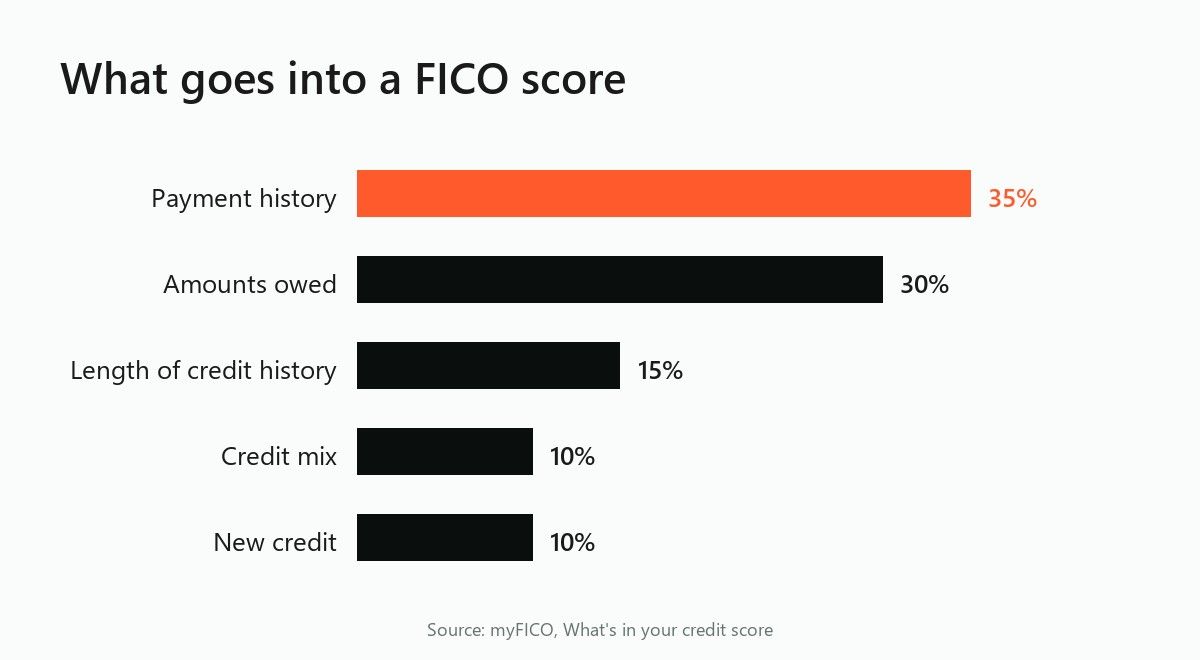
Payment history and amounts owed both require the account to be in your file to begin with, and since most payday loans aren't furnished to the major bureaus, neither factor engages at all. The utilization part of amounts owed, how much of your available revolving limit you're using, has nothing to work with on a payday loan, which has no limit.
Credit mix looks at the variety of account types on your report, cards, installment loans, mortgages, but FICO is explicit that "it's not necessary to have one of each" to score well. An unreported payday loan can't contribute to that mix either, because it was never on the report to count.
The same logic extends to length of credit history and new credit: an account that never gets furnished can't add age to your file, and it can't register as a new trade line either. Every one of the five factors depends on the account existing in your credit file first. A payday loan usually skips that step entirely, start to finish.
Put plainly: the loan is nearly invisible to your score while it's current, but the consequences of missing a payment are not invisible at all once collections gets involved. That gap between "current" and "delinquent" is the whole story for a payday loan's credit impact, and it's worth sitting with before you assume a well-managed payday loan is quietly doing you any favors.
What This Means If You're Trying to Rebuild Credit
If you took out a payday loan and paid it back on time, don't expect a bump to your score for it. The loan almost certainly never touched your file. That's not a penalty, it's just how the reporting works given the closed-end, unreported nature of the product.
That can feel counterintuitive if you're used to thinking of on-time payments as automatic credit-building activity. With a reported installment loan or a credit card, that logic holds. With a payday loan, it mostly doesn't, because the account was never in position to report anything in the first place. Knowing that upfront can save you from a frustrating surprise the next time you pull your score expecting to see a change, and it can also stop you from over-relying on payday borrowing as a way to prove you pay your bills on time.
If you're actively rebuilding after a default or a collections account tied to a payday loan, the classification question you've just answered is step one, not the whole plan. Knowing that a payday loan is closed-end credit that generally skips the major bureaus tells you why it didn't help your score before. It doesn't tell you what to do next, and that's a longer conversation than one article section can responsibly cover. For the full sequence, from disputing errors to choosing accounts that actually build a file, the 12-month plan for rebuilding credit lays out the roadmap in order.
One practical alternative worth knowing about if you need small-dollar credit again: some credit unions offer Payday Alternative Loans, closed-end loans repaid in scheduled installments. Ask the credit union whether it reports to the major bureaus before counting on one for rebuilding. If reporting is part of why you're borrowing, that's a meaningful difference to confirm upfront. A small installment loan that does report can be part of a rebuilding strategy in a way a payday loan usually can't, precisely because it clears the first hurdle a payday loan never does: showing up in your file at all.
Your Next Step This Week
Pull your credit reports from all three bureaus through the free official site, annualcreditreport.com, and check whether your payday loan actually shows up. If it's absent, that confirms what the CFPB's guidance predicts and tells you the loan isn't the reason your score looks the way it does. If a collections account related to it does appear, that's the specific item to address first, and the rebuild roadmap referenced above walks through how, in order, starting this month rather than someday.
Frequently Asked Questions
Is a payday loan installment or revolving?
Neither, technically. Under Regulation Z, a payday loan is closed-end credit: a single advance repaid in one payment with one fixed fee. It shares the closed-end category with installment loans, but it isn't a multi-payment installment product, and it's not revolving because there's no credit limit that replenishes the way a credit card's does.
Is a payday loan variable or fixed rate?
Fixed. The cost is a flat dollar fee set at the time you borrow, disclosed as an APR because Regulation Z requires closed-end finance charges to be expressed that way. It doesn't move with an index the way some variable-rate credit products can.
What is an example of closed-end credit?
Payday loans, personal installment loans, auto loans, and mortgages are all closed-end credit: you borrow a set amount once and repay it on a defined schedule, whether that's a single payment or several. Credit cards and other lines of credit are the open-end, revolving counterpart.
Will a payday loan help my credit score?
Generally not. The CFPB says payday loans are typically not reported to the three major bureaus, so on-time payments usually don't build your score. If the loan defaults and goes to collections, that account can be reported and can hurt your score instead.