




You applied at a bank, got the polite decline, and now you're staring at a search results page full of ads promising installment loans without a credit check. What I want you to know before you click any of them: the phrase is real marketing, and it still leaves out most of the story. Almost no legitimate lender skips underwriting entirely.
What they skip is the traditional pull from Equifax, Experian, or TransUnion's mainstream credit file, the one that produces your FICO score. What replaces it is a different kind of check. Understanding that difference is what lets you tell a real shortcut from a sales pitch.
You're rejected by a bank, weighing an online installment offer, trying to figure out if "no credit check" means no strings or just different strings. This article walks through what actually happens when you apply, what these loans really cost when a named lender's own numbers are on the table, and where state law puts a ceiling on how bad it can get.
What "No Credit Check" Really Means
No federal rule defines "no credit check." It's a marketing phrase with no regulatory meaning behind it. What it almost always means in practice is that the lender isn't pulling your file from one of the big three bureaus the way a mortgage or auto lender would. Instead, most no-credit-check installment lenders run your application through a specialty consumer reporting agency built specifically for subprime and alternative lending.
Clarity Services is the name you'll see most often in this space. Experian acquired Clarity Services in October 2017, so Clarity's alternative-data file now sits inside Experian's alternative financial services division. FactorTrust is the other major name. FactorTrust is a TransUnion company; TransUnion completed that acquisition in 2017.
The Consumer Financial Protection Bureau's own list of specialty consumer reporting companies documents this whole category, including DataX and Teletrack, both Equifax-affiliated. If a lender says it skips a credit check, there's a real chance one of these names is pulling your file instead of the one you're used to.
The second piece is your bank account itself. Lenders in this category typically require a linked checking account, then read your transaction history directly: income deposits, balance patterns, existing debits going out.
Think of it this way: they've traded a score built from your borrowing history for a live read of your cash flow. That's a substitution in the underwriting method, and the underwriting itself still happens.
What Online Installment Loans With No Credit Check Charge
Rate ranges in this space vary wildly, and a lot of what you'll find on comparison sites is secondhand and inconsistent. Below is what checks out against a lender's own disclosure, plus one comparison point that isn't part of this "no credit check" category at all.
- OppLoans: APR range of 129% to 195%, loan amounts from $500 to $5,000, terms of 9 to 18 months. This is confirmed on OppLoans' own California rates and terms page, which also walks through a worked example: a $2,000 loan at 160% APR paid over 9 months comes out to 9 monthly payments of $394.58. Rates are state-specific, so what you see quoted for California won't match every state OppLoans operates in.
- RISE Credit: up to 299% APR in states without a lower cap, per third-party rate trackers, with rates tending to cluster near whatever cap a given state sets. This range comes from third-party trackers rather than RISE's own disclosure, so treat it as secondary-sourced.
- NetCredit: NetCredit doesn't publish a specific APR figure until you select a state on its rates and terms page, and loans are originated through a bank-partnership model rather than directly by NetCredit itself. Select your state on that page to see the rate that applies to you.
- Avant: for contrast, Avant sits well outside the "no credit check" category and does run a soft credit check, but it's useful for showing how wide the range in bad-credit lending is: loans from $2,000 to $35,000, APR from 9.95% to 35.99%, with an administrative fee up to 9.99%.
You'll also run into CashNetUSA and Speedy Cash, which offer multi-payment installment products alongside their storefront payday loans. Pricing varies by state, so check each lender's state rate page and the disclosure box before you apply.
The Real Cost Difference: Installment Versus a Payday Rollover
This is where the installment structure earns its keep, and the math is worth doing slowly instead of taking anyone's word for it.
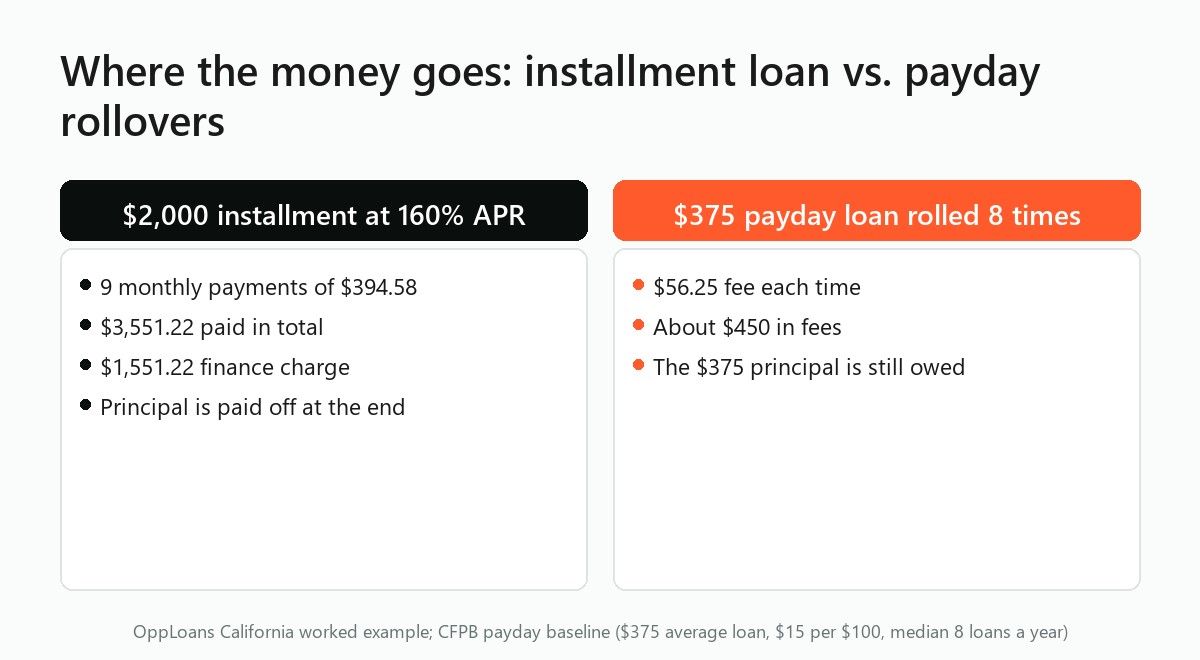
Take that OppLoans example again: a $2,000 loan at 160% APR, paid off in 9 monthly installments of $394.58, the same figures verified above. Multiply it out and nine payments of $394.58 comes to $3,551.22.22 total.
Subtract the $2,000 you borrowed and the finance charge is $1,551.22. That's a real number, and it's not small.
But every one of those nine payments chips away at the balance, because the loan amortizes: part principal, part interest, every month, until it hits zero. Now compare that to a single-payment payday loan that gets rolled over instead of paid off. Using the CFPB's own payday baseline, a typical rollover pattern runs a median of about 8 loans a year at $15 per $100 borrowed, on an average loan of roughly $375.
Roll that $375 loan eight times and you're paying about 8 times $56.25, which comes to roughly $450 in pure fees. The part that matters most: none of that $450 touches the principal. At the end of that sequence, you still owe the full $375 you started with. The installment borrower above owes nothing after month nine.
That pattern holds beyond these two examples. CFPB research on longer-term high-cost online loans found that loans structured with a single balloon payment, the same lump-sum structure a payday loan uses, are far more likely to end in default than loans that amortize in equal installments. Roughly 1 in 5 payday loan sequences and 1 in 3 single-payment auto title loan sequences end in default, often after repeated re-borrowing.
An installment structure forces the principal down every month. A balloon structure lets fees pile up on a debt that never shrinks until you find one large payment all at once.
If you want the single-payment version of this comparison spelled out in more detail, the payday-specific breakdown of no-credit-check lending covers that side of the math on its own.
What State Law Actually Limits
State rate caps set the ceiling on what these loans can cost, and they vary more than most borrowers expect.
Virginia caps short-term and installment loan interest at a simple annual rate of 36%, under Code § 6.2-1817(A)(1). On top of that, lenders can add a monthly maintenance fee of whichever is smaller: 8% of the original loan amount or $25, plus a $25 maximum deposit-return fee and a $20 maximum late fee. A separate provision, § 6.2-1818.3, caps aggregate fees at 50% to 60% of the original loan amount depending on size. This structure came out of Virginia's 2020 Fairness in Lending Act, which explicitly covers payday, title, installment, and fintech lenders alike, corroborated by Pew's analysis.
California took a similar approach through the Fair Access to Credit Act, known as AB 539, effective January 1, 2020. Consumer loans between $2,500 and $9,999 made by a licensed finance lender are capped at 36% simple annual interest plus the Federal Funds Rate. An administrative fee up to $75 is allowed on loans between $2,500 and $4,999, and for loans of $5,000 or more, any administrative fee gets folded into the rate cap itself rather than charged separately. This comes from California's Department of Financial Protection and Innovation, the regulator that oversees these licensees, and from the AB 539 bill text itself.
That cap only covers loans in the $2,500 to $9,999 range. The $2,000 OppLoans example above, priced at 160% APR, falls below that band, which is exactly why it isn't subject to California's 36% cap.
Texas tells a different story, and it's worth knowing before you assume installment automatically means cheaper. Texas installment lending runs through Chapter 342 of the state finance code rather than the credit-access-business structure that governs Texas payday and title loans (that CAB structure is its own loophole, covered in detail in this site's breakdown of Texas payday loan laws). The Texas Office of Consumer Credit Commissioner's 2025 study of consumer loan products found that Chapter 342-E signature loans run 18% to 30%, with a blended rate up to roughly 44%, while Chapter 342-F loans run 80% to 113%.
The 342-F range, and the top of 342-E's blended rate, sit above Virginia's and California's 36% caps. Your state's cap, more than the loan structure, sets the rate.
Zoom out and the picture gets more reassuring than the "no credit check" marketing suggests. According to the National Consumer Law Center's fact sheet on state APR caps, 43 states plus the District of Columbia cap a $2,000, 24-month installment loan, with Delaware and Missouri standing out as the notable states with no such cap. Most states already limit how high this product can go, whether or not the lender is doing a traditional credit check.
The Protection That Applies No Matter Who Checks Your Credit
Whatever underwriting method a lender uses, Truth in Lending Act disclosure rules still apply. Regulation Z requires a disclosure box showing your APR, finance charge, amount financed, payment schedule, and total of payments (12 CFR § 1026.18), before you sign. That box is where the OppLoans-style math above should already be sitting in front of you, spelled out in dollars rather than left for you to calculate. If a lender can't or won't show you that box before you commit to anything, that's a bigger red flag than which bureau they pulled.
Between that disclosure requirement and your state's own rate cap, you already have more protection built into this transaction than "no credit check" marketing implies. Read the disclosure box before you sign; it already spells out the answer that marketing leaves out.
How to Read an Offer Before You Sign It
Before you accept any installment offer that advertises no credit check, run through this in order:
- Find the APR on the disclosure box first; a manageable monthly payment can still sit on top of a triple-digit APR.
- Multiply the payment by the number of payments to get your true total cost, the way this article did with the OppLoans example. Compare that total to what you're borrowing.
- Check whether your state caps installment loan rates. Virginia caps this product at 36% simple annual interest. California applies the same 36%-plus-Federal-Funds-Rate cap, but only to loans of $2,500 to $9,999; smaller and larger loans fall outside it. Texas allows considerably more. Look up your own state's cap before you assume a number is normal. Ask what the lender is checking. If they mention Clarity, FactorTrust, or a bank-account verification step, that's the underwriting substitution this article describes; this site's breakdown of what lenders actually check covers the same question from the payday side.
- Compare against a lower-cost alternative first. If you're weighing this against other short-term borrowing options, the broader short-term loan comparison on this site lays out where installment lending sits next to payday and title loans, and the piece on lower-cost alternatives covers credit-union and bank-based options worth checking before you accept a triple-digit APR.
None of this means these loans are never the right call. Sometimes a $2,000 installment loan that amortizes really is the better option next to a payday loan you know you'll have to roll over. Your real protection in that comparison comes from the APR, the amortization structure, and your state's rate cap. Pull up your state's cap and the lender's disclosure box before you sign anything.
Frequently Asked Questions
Do installment loans without a credit check really skip all underwriting?
No. Most lenders in this category skip the traditional FICO pull from Equifax, Experian, or TransUnion's mainstream file, but they substitute a specialty bureau like Clarity Services or FactorTrust, plus a direct read of your bank account activity, before approving anything.
What's the difference between Clarity Services and FactorTrust?
Both are specialty consumer reporting agencies built for subprime and alternative lending rather than mainstream credit scoring. Clarity Services is now part of Experian, acquired in October 2017. FactorTrust is a TransUnion company, also acquired in 2017. No-credit-check installment lenders typically pull from one or the other in place of a traditional bureau file.
How much does a $2,000 no-credit-check installment loan cost?
Using OppLoans' own worked example, a $2,000 loan at 160% APR paid over 9 months comes to 9 payments of $394.58, or $3,551.22 total, a finance charge of $1,551.22. Your actual cost depends on the lender's rate, your state, and your loan term, so check the disclosure box before you sign.
Are installment loans cheaper than payday loans?
It depends on whether the payday loan gets rolled over. A payday loan paid off in one payment can cost less than a long installment loan. A payday loan rolled over repeatedly racks up fees on a principal that never shrinks, while an installment loan amortizes the balance down every month.
Does my state limit how much these lenders can charge?
In most states, yes. Virginia caps installment loan interest at 36% simple annual, plus limited fees. California caps loans between $2,500 and $9,999 at 36% plus the Federal Funds Rate. Texas allows considerably higher rates under its Chapter 342 installment provisions.