




You typed "installment loans" into a search bar because a single lump-sum payday loan felt like too much risk, and the ad that popped up promised something friendlier: fixed monthly payments, no balloon due date, approval in minutes. Before you hand over your bank account number, sit with one question: is this installment loan legit, or is it a scam wearing a nicer outfit than the payday lenders you already know to avoid?
That question deserves a real answer, not a gut feeling. Searches for installment loans have climbed as more borrowers look for an alternative to a single lump-sum payday loan, and the market that's grown up to meet that demand includes licensed lenders alongside operations built to look like one. Installment loans are structured differently from payday loans, and that structure changes what "legit" actually looks like: a payday loan is one lump sum due on your next payday, while an installment loan spreads repayment across several fixed payments over weeks or months.
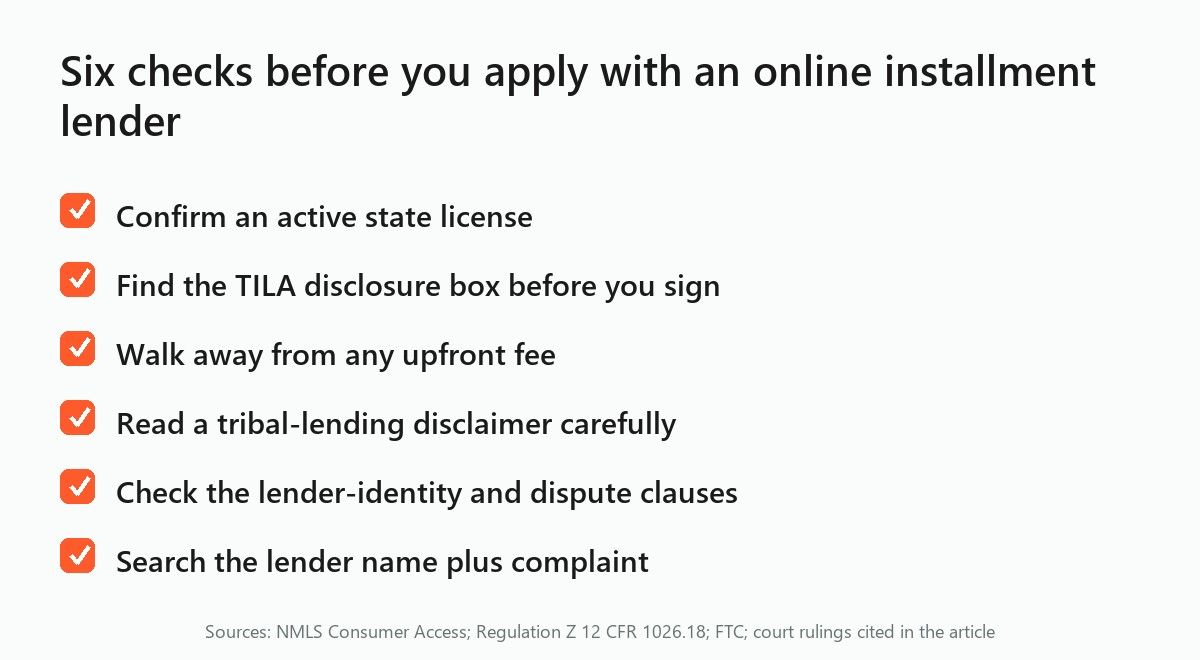
This difference matters more than it sounds like it should, because the paperwork, the disclosures, and even the scam patterns look different too. The checklist below walks you through six checks you can run before you apply anywhere, in the order that matters most.
Check 1: Confirm the Lender Holds an Active State License
Most non-bank installment lenders need a state license, and NMLS Consumer Access, the nationwide registry run by the Conference of State Bank Supervisors, shows whether one is on file. Search the company's exact legal name, the one printed on its license, rather than the marketing name shown on the ad, and check whether the license covers your state specifically. A license for Texas doesn't help you if you live in Ohio and the site never mentions Ohio at all.
This site already explains how to use NMLS Consumer Access in its guide to what lenders actually check. If you have never used NMLS Consumer Access before, start there. The record you find should show a license number and the specific states it covers, and that is the information you want to hold up against whatever the lender's own site claims.
A blank search result isn't proof of a scam by itself. But if the name on the ad, the name on the loan agreement, and the name on file with NMLS are three different companies and nothing ties them together, treat that as a reason to stop and ask questions before you submit anything.
Check 2: Look for the TILA Disclosure Box Before You Sign
Federal law requires closed-end consumer loans, installment loans included, to show you a standardized disclosure box before you sign anything. Closed-end credit means a loan for a fixed amount that you borrow once and repay on a set schedule, which describes almost every installment loan you'll come across. Under Regulation Z, the rule that implements the Truth in Lending Act, that box has to spell out the annual percentage rate (APR), the finance charge, the amount financed, your payment schedule, and the total of all payments you will make over the life of the loan (12 CFR 1026.18).
Here is the practical test: if you cannot find that box, or the lender wants your bank routing number before showing you the APR and total payment figure, walk away. A licensed lender shows you the math first and asks for your money second. A lender that reverses that order is telling you something about how it operates, whether it intends to or not.
Read the box slowly once you find it. Match the payment schedule against what the sales rep or the site described verbally. If the numbers on the page don't match what you were told on the phone, trust the written disclosure over the sales pitch and ask why they differ.
Check 3: Spot the Advance-Fee Scam Pattern
The Federal Trade Commission describes this trap in plain language: scammers promise guaranteed approval regardless of your credit history, using language like "bad credit, no problem," and then ask for an upfront payment, framed as an "insurance fee," a "processing fee," or an "application fee," before they will release funds already supposedly approved.
The FTC draws a specific line here that is worth memorizing. Real lenders can charge an application or appraisal fee as part of underwriting your loan. What no legitimate lender does is tell you that paying a fee guarantees your approval. Guaranteed approval in exchange for money up front is the tell.
If you get an unsolicited phone call promising credit that is "virtually guaranteed" contingent on an advance payment, that call itself can violate the FTC's Telemarketing Sales Rule, per the same FTC guidance.
Compare that to how a legitimate origination fee works. A real lender deducts its fee from the loan proceeds before disbursing the rest to you, so you never wire or Zelle money separately just to release funds. If a lender asks you to send a gift card, a wire transfer, or a prepaid debit card balance before it will release your loan, stop the process entirely. This site's broader roundup of payday loan scam patterns covers the wider taxonomy, including phantom-debt collectors and lender impersonators, if you want the fuller picture beyond installment loans specifically.
Check 4: Read a "Tribal Lending" Disclaimer Correctly
Some online installment lenders disclose that they operate as an arm of a federally recognized tribal nation and claim tribal sovereign immunity shields them from state licensing and interest rate caps. Treat that disclaimer as something you need to verify, not proof the loan is legitimate. Three federal appeals courts have each looked at different tribal lending structures and found ways around the sovereign immunity claim when the loan reached a borrower who never set foot on tribal land.
Start with the Second Circuit. In Otoe-Missouria Tribe of Indians v. New York State Department of Financial Services, decided October 1, 2014, the court denied the tribal lenders' request to block New York regulators from acting against them, agreeing that the lower court reasonably found the loan transactions did not occur on tribal land simply because the lender claimed tribal affiliation.
Next, the Ninth Circuit. In CFPB v. CashCall, Inc., decided May 23, 2022, the court ruled that CashCall's tribal choice-of-law clause was unenforceable because CashCall itself, not the tribal entity named on the paperwork, was the real lender under an "economic reality" test. Enforcing tribal law in that case would have violated the borrowing states' own public policy.
Most recently, the Fourth Circuit. In Williams v. Martorello, decided July 16, 2025, the court held that a non-Native businessman running a so-called "rent-a-tribe" lending operation remained personally liable under civil RICO even after the tribal entities themselves were dismissed on sovereign immunity grounds, because online lending activity reaching an off-reservation borrower is governed by state law rather than tribal law. The loans at issue charged Virginia borrowers APRs exceeding 700%, roughly sixty times Virginia's 12% legal limit, and the ruling upheld a roughly $44 million RICO judgment.
Three different circuits, three different tribal lending structures, and each court found a path around the sovereignty claim once it examined who actually controlled the loan. That track record matters for you in a practical way: courts haven't settled that tribal sovereignty automatically blocks state law, which means a tribal disclaimer tells you the lender is claiming an unresolved legal defense, not that the loan is lawful in your state. If a lender's disclaimer mentions tribal affiliation, run the same license check from Check 1 anyway: ask the lender directly whether it holds a license for your state, and treat a refusal to answer that question plainly as its own red flag. Don't sign on the bet that a court will rescue you later.
Check 5: Read the Lender-Identity and Dispute Clauses in the Agreement
Before you sign, find three specific things in the loan agreement itself. First, who is actually named as the lender: does the entity match the name you researched on NMLS Consumer Access, or is there a different company buried in the fine print? Second, is there a forced arbitration clause, meaning you'd agree in advance to settle any dispute through a private arbitrator instead of a courtroom, which typically waives your right to sue or join a class action? Third, which state's law does the agreement say governs the loan, and does that match the state where the lender claims to be licensed?
Read the arbitration clause in full rather than skimming it, since it is often where a lender's actual terms diverge furthest from what the marketing promised.
A mismatch between any of these three points doesn't automatically prove fraud. It's still a reason to slow down and ask the lender directly, in writing, who the actual lender is and why the governing-law clause names a different state than the license does. A legitimate lender can answer that question clearly. One that dodges it, or gives you a different answer each time you ask, is showing you exactly what you need to know.
Check 6: Search the Lender Name Plus "Complaint"
Before you apply, run a plain search of the lender's exact legal name alongside the word "complaint," and separately check the Better Business Bureau and your state attorney general's consumer protection page for open actions or a pattern of unresolved complaints. A handful of complaints doesn't disqualify a lender automatically; even well-run companies get complaints. What you're looking for is a pattern: repeated complaints about undisclosed fees, phantom debt collection, or a lender that stopped responding once funds changed hands.
If you want the broader context on how installment loans stack up against payday loans and title loans structurally, this site's comparison of short-term loan types covers that ground, and it's worth reading before you decide which product actually fits your situation in the first place.
What to Do If You Already Paid a Fee or Signed With a Lender That Failed These Checks
If you already wired an advance fee or signed with a lender that fails one or more of these checks, act in a specific order rather than all at once.
- Contact your bank or card issuer first. If you paid by debit card, credit card, or wire transfer, ask about reversing the charge or filing a dispute immediately; the sooner you report it, the better your odds of recovery.
- File a complaint with the Consumer Financial Protection Bureau. This site's guide to filing a CFPB complaint walks through the process step by step, and the same process applies whether the lender called itself a payday lender or an installment lender.
- Report the advance-fee pattern to the FTC directly. Advance-fee loan scams fall squarely under the FTC's own enforcement authority.
- File with your state attorney general's office if the lender operates in your state or targeted you there, even if the lender claims to be based elsewhere.
- Stop any further contact or payment requests. If anyone asks for a second fee, don't send it, whatever they call it.
None of this undoes a payment that already left your account, but reporting it does two things: it creates a paper trail that can help you if the charge gets disputed, and it gives regulators a record of the pattern.
Frequently Asked Questions
Are online installment loans legit?
Some are licensed, regulated lenders, and some are scams. The "installment" label alone tells you nothing either way. What separates them is checkable: an active license for your state on NMLS Consumer Access, a TILA disclosure box before you sign, and no upfront fee to release funds. A lender that fails any one of those checks is a red flag.
How do I verify an installment lender's license?
Search the lender's exact legal name on NMLS Consumer Access and confirm the license is active and covers your state specifically. This site's guide to what lenders actually check covers NMLS Consumer Access if you haven't used the tool before.
What is the advance-fee loan scam?
It is when a lender promises guaranteed approval regardless of your credit and then demands an upfront payment, often called an "insurance," "processing," or "application" fee, before releasing funds. The FTC is explicit that no legitimate lender ties a fee payment to a guarantee of approval.
Does a "tribal lending" disclaimer mean the loan is illegal?
A tribal disclaimer alone doesn't make a loan illegal, but it doesn't by itself exempt the loan from state law either. The Second, Ninth, and Fourth Circuits have each rejected that shield for online loans to off-reservation borrowers in the cases before them. Treat the disclaimer as an unresolved legal claim.
What should I check in the loan agreement before signing?
Confirm the lender's name in the agreement matches the name you verified through NMLS, look for a forced arbitration clause, and check which state's law the agreement says governs the loan. A mismatch between the licensed state and the governing-law clause is worth a direct question to the lender before you sign.