




Somebody at the loan office just told you the installment loan is the "responsible" choice, the one that beats a payday loan. Maybe that's true. Maybe it isn't. The only way to know for sure is to run an installment loan calculator on the actual number they quoted you, not the sales pitch that came with it.
A fixed rate and a fixed term don't automatically mean a fair price. The rate itself does the heavy lifting, and until you see what that rate compiles into over the life of the loan, you're taking someone else's word for it.
Before you sign anything, sit down and do the math yourself. It's not hard, and once you see it laid out, you know exactly what a lender's numbers should look like: fixed payments, fixed term, principal that goes down every month instead of a fee that resets. What you need is the actual arithmetic behind three example APRs, one set by statute and two representative rates, worked out on the exact loan size and term you're likely comparing, so you can see precisely where your own offer lands next to each one.
The Formula Behind Every Installment Loan Payment
The Truth in Lending Act's Regulation Z, specifically Appendix J, sets the actuarial method lenders use to calculate and disclose an APR on closed-end credit. The formula below is the standard amortization math that shows you what a given APR actually costs, whether you're looking at a $1,000 small-dollar loan or a $30,000 auto loan.
Here's the formula:
M = P × [r(1+r)^n] / [(1+r)^n − 1]
Break down what each letter means before you touch a calculator.
- M is your monthly payment, the number you're solving for.
- P is the principal, the amount you actually borrow.
- r is your monthly interest rate. Take your APR and divide by 12. A 36% APR becomes a monthly rate of 0.03.
- n is the number of monthly payments in your term. A six-month loan means n = 6.
Compute (1+r)^n. Multiply it by r for the top. Subtract 1 from it for the bottom. Divide top by bottom and multiply by P.
Written out like that, it looks intimidating. Plugged into an installment loan payment calculator, or even a basic spreadsheet, it takes seconds. The point of walking through it here is so you understand what the calculator is actually doing, and so you can catch it if a lender's own numbers don't match.
Three Worked Examples: Using an Installment Loan Payment Calculator on the Same $1,000 Loan
Here's where an installment loan payment calculator earns its keep. Run the same $1,000 principal, a realistic size for a small-dollar installment loan (Mississippi's licensed small installment product, for comparison, covers loans from $500 to $2,500), the same six-month term, through one set rate and two representative rates, and watch what changes. Only the rate moves. Everything else holds still.
- 36% APR (Illinois rate cap): monthly rate r = 0.03. Monthly payment: $184.60. Total of payments: $1,107.60. Total interest: $107.60.
- 30% APR (mid-range licensed lender): monthly rate r = 0.025. Monthly payment: $181.55. Total of payments: $1,089.30. Total interest: $89.30.
- 90% APR (high-cost, fee-capped state): monthly rate r = 0.075. Monthly payment: $213.04. Total of payments: $1,278.24. Total interest: $278.24.
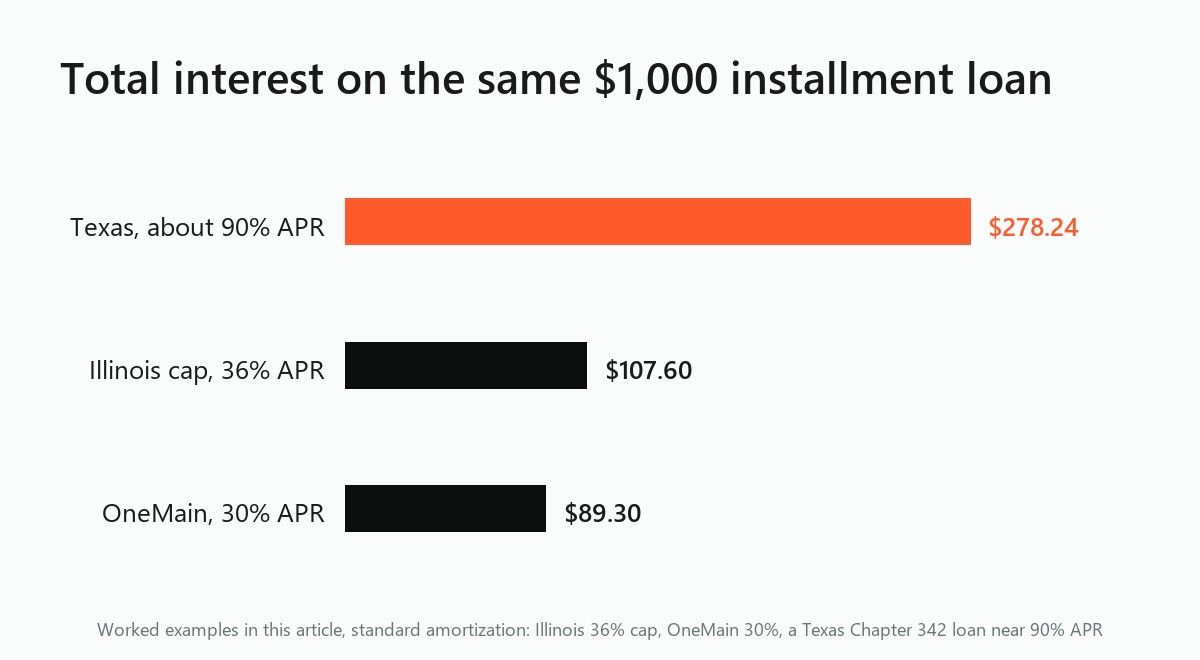
Notice the middle entry. It costs less than the top one, not more. It costs less than the capped example because a cap is a ceiling. A licensed lender can price well under it depending on the borrower.
What separates these three numbers is a single input: the APR your lender quotes you. That's exactly why this comparison works as a stand-in for your own offer. Swap in your own principal, your own term, and your own quoted APR, and the same formula tells you what you're actually signing up for, dollar for dollar.
36%: What a state rate cap buys you
Illinois caps the all-in rate on essentially every consumer loan made in the state at 36% APR. The Illinois Predatory Loan Prevention Act (815 ILCS 123) took effect in March 2021 and applies the same annual percentage rate math the Military Lending Act uses for servicemembers, extending it to every civilian borrower in the state. A lender who charges more than that in Illinois loses more than the excess. The loan becomes void, and the lender forfeits the right to collect principal, fees, or interest at all.
For the mechanics of how that cap gets calculated and enforced, see our breakdown of Illinois' 36% all-in rate cap in our Illinois payday loan laws guide, or the federal version of the same math in our explainer on the same 36% MAPR ceiling that protects servicemembers under the Military Lending Act. A 36% cap only sets the most a lender can legally charge. Your offer can sit well under it.
30%: A licensed lender's market rate
The middle example reflects a representative rate we chose near the top of OneMain's disclosed range. OneMain Financial, a national licensed consumer finance company, discloses a fixed APR range of 11.99% to 35.99% on its unsecured loans, according to its own Loan Amounts and Fees disclosure. That's a wide band, and where you land in it depends on your credit file, income, and state.
It isn't an official industry average, and it isn't the rate everyone gets. Two borrowers with different credit files, different incomes, and different states can walk away with two very different numbers from the same lender. Treat 30% as a realistic planning number, then compare it against whatever your specific offer quotes.
90%: What a fee-based ceiling actually looks like
Some states set no APR ceiling and cap dollar fees instead. Under Texas Finance Code Chapter 342, Subchapter F, lenders licensed through the state's Office of Consumer Credit Commissioner can charge an acquisition charge plus a monthly installment account handling charge on small installment loans, with no ceiling on the resulting annual percentage rate. Texas has no APR ceiling, only capped dollar fees, which is how the effective APR runs this high while staying legal. The state's own regulator licenses and oversees these lenders through its regulated-lenders program.
The 90% figure used in the table above is a representative high-cost-state example, the kind of rate that shows up when a state's fee structure permits it. It isn't a single official statewide average. For the fuller picture of how this fee structure operates, our guide covers why Texas installment loans can legally run this high.
Nationally, 31 states plus D.C. cap small installment loan APRs somewhere between 17% and 36%, while Delaware and Missouri impose no cap at all, according to NCLC's 2025 state-by-state survey. Which bucket you fall into depends entirely on where you live and where the loan is originated. That's why the same $1,000 loan can cost $107.60 under Illinois' cap and far more in a high-cost state like our 90% example.
What Rolling a Payday Loan Would Cost for the Same Six Months
Now put those three installment numbers next to the alternative: rolling over a payday loan instead. To make a fair, apples-to-apples comparison, this example scales the payday loan up to the same $1,000 principal used above. Worth saying plainly: a payday loan that size isn't realistic in most states. State law commonly caps payday loan amounts well below $1,000 (see our Mississippi and Florida payday law guides).
The $1,000 figure here exists only so the principal matches across every scenario in this article. It isn't a claim that loans this size are typically available to a payday borrower. A six-month rollover isn't a worst-case scenario either. The CFPB has found that more than 80% of payday loans get rolled over or followed by another loan within 14 days, and roughly half of borrowers end up in sequences of ten loans or more.
The CFPB puts the typical payday fee at $15 per $100 borrowed per two-week period, a structure our guide on how payday loan fees convert to a 391% APR walks through in detail. On $1,000, that fee comes to $150 every two weeks. Six months runs 13 two-week periods.
13 periods x $150 per period = $1,950 in total fees paid, with the full $1,000 principal still owed at the end.
Here's the piece that trips people up. A payday loan fee doesn't touch the principal at all. Pay that fee 13 times and you've paid nearly double the loan amount in fees alone. You still owe just as much as the day you signed.
Compare that to the 90% APR installment example, the most expensive tier in the comparison above. It costs $278.24 in total interest, and the loan is completely paid off at month six. Even the priciest legal installment loan in this comparison costs a fraction of what a rolled-over payday loan does, because an installment loan actually retires itself.
How to Read Your Own Loan's Numbers Before You Sign
You don't have to take a loan officer's word for any of this. Every closed-end installment loan comes with a Truth in Lending disclosure box, required by Regulation Z. Here's how to use it, step by step.
- Find the APR. It's a required disclosed figure, separate from the interest rate. The APR reflects your true annual cost, fees included, not just the sticker rate.
- Find the finance charge. This is the total dollar cost of credit over the life of the loan, the same figure this article calls total interest.
- Find the total of payments. Add up every scheduled payment. It should roughly match the amount financed plus finance charge.
- Plug your own numbers into the formula above. Take the APR on the disclosure, divide by 12 for r, count your loan term for n, and run the calculation yourself.
- Compare what you get to what's printed on the page. If your number and the lender's number don't match, ask why before you sign anything.
If your state caps installment loan APRs, check where that cap sits and where your offer lands relative to it. If your state doesn't cap them, running the math yourself matters even more, since nothing else is checking the lender's work for you.
Keep a copy of the disclosure box after you sign, too. If your account statement ever shows a different payment or a different finance charge than what the original disclosure listed, you have the paper to point back to, and you'll know whether the difference is a clerical error or something worth calling the lender about. For more on how installment loans stack up against other short-term borrowing options beyond payday loans, our guide on how installment loans compare with other short-term credit covers the full range of products you might be choosing between.
Frequently Asked Questions
How do I calculate my installment loan payment by hand?
Use M = P × [r(1+r)^n] / [(1+r)^n − 1]. Convert your APR to a monthly rate by dividing by 12 (that's r), count your total number of monthly payments (that's n), and plug in your principal (P). A $1,000 loan at 36% APR over six months works out to a monthly payment of $184.60.
Is a 36% APR good for an installment loan?
A 36% APR sits at the ceiling Illinois sets as its maximum allowed rate on consumer loans. It's meaningfully cheaper than a rolled-over payday loan, but it isn't automatically the cheapest option available. A licensed lender's market rate can land below 36%, so compare your actual offer against the cap rather than assuming the cap is what you'll pay.
Why can an installment loan cost less than a payday loan even at a high APR?
Every installment payment reduces the principal you owe, while a rolled-over payday loan fee does not. A $1,000 installment loan at a high 90% APR costs $278.24 in total interest over six months, fully paid off. Rolling a $1,000 payday loan for six months costs $1,950 in fees, with the full $1,000 principal still owed at the end.
What's the difference between interest rate and APR on an installment loan?
The interest rate reflects only the cost of borrowing the principal. The APR folds in the interest rate plus other required finance charges, expressed as a yearly rate. Regulation Z requires lenders to disclose the APR because it's the fuller picture of what a loan costs, and it's the figure the amortization formula uses as r.
Can a lender charge more than my state's APR cap?
Not legally, in a state that has one. Illinois voids loans that exceed its 36% cap and bars the lender from collecting principal, fees, or interest. Not every state has a cap, though. States like Texas allow fee structures that produce APRs far above 36%, which is why your own state's rules matter as much as the payment math.