




You typed "income based payday loans" into a search bar because you want a straight answer: how much can you actually borrow based on what you make? Most of what comes up will tell you that a lender looks at your income and sizes an offer around it. That's true, but it skips the part that actually determines your legal ceiling in a handful of states.
Here's the short version. Idaho, Washington, and Wisconsin write an exact percentage-of-income formula into their payday statutes, and in those three states the phrase "income-based payday loan" has a legal meaning you can look up and calculate yourself. In Florida, Texas, and Illinois, by contrast, the phrase describes a lender's own underwriting rather than a statutory percentage.
If you live in Idaho, Washington, or Wisconsin, the formula below tells you your real ceiling before you ever fill out an application. If you live in a state this article checked that uses a different approach, such as Florida's flat dollar cap or Illinois's rate cap, the number a lender offers you is still shaped by your income, but it isn't held to a statutory percentage.
Marketing Term vs. Statutory Cap: What "Income-Based" Means Where You Live
When a lender or a comparison site advertises an income-based payday loan, they almost always mean one thing: their underwriting formula sizes your offer using your stated or verified income, whether that's a paystub, a bank statement, or a third-party income-verification tool. That's standard practice everywhere payday lending is legal. It happens whether or not your state imposes any statutory limit at all, and it tells you nothing about your actual legal ceiling.
State law is a separate layer entirely, and it splits into three distinct approaches once you look past the marketing copy.
- Income-percentage caps: the law ties your maximum loan directly to a percentage of your gross monthly income. Idaho, Washington, and Wisconsin do this for payday loans specifically.
- Flat dollar caps: the law sets one fixed ceiling for every borrower, regardless of what they earn. Florida is the example here.
- Rate caps with no size limit: the law regulates what a lender can charge and leaves loan size alone. Illinois took a different approach and capped the rate instead of the amount.
A fourth category exists too: states where neither the loan size nor the effective rate is meaningfully capped, because a licensing structure lets lenders route around the limits that would otherwise apply. Texas falls into that group.
Knowing which category your state falls into matters more than knowing your income. A borrower earning $5,000 a month in Wisconsin can legally access a larger loan than a borrower earning the same amount in Florida, simply because of which formula governs the loan in each state.
The Three States With Real Percentage-of-Income Caps
These three states each write their limit differently, but all three share the same underlying idea: the statute names a percentage of your gross monthly income, and each pairs that percentage with a dollar figure that takes over once your income climbs high enough. Idaho structures its rule as a percentage paired with a separate flat aggregate-principal ceiling, while Washington and Wisconsin both build an explicit "lesser of $X or Y%" formula directly into the same statutory sentence.
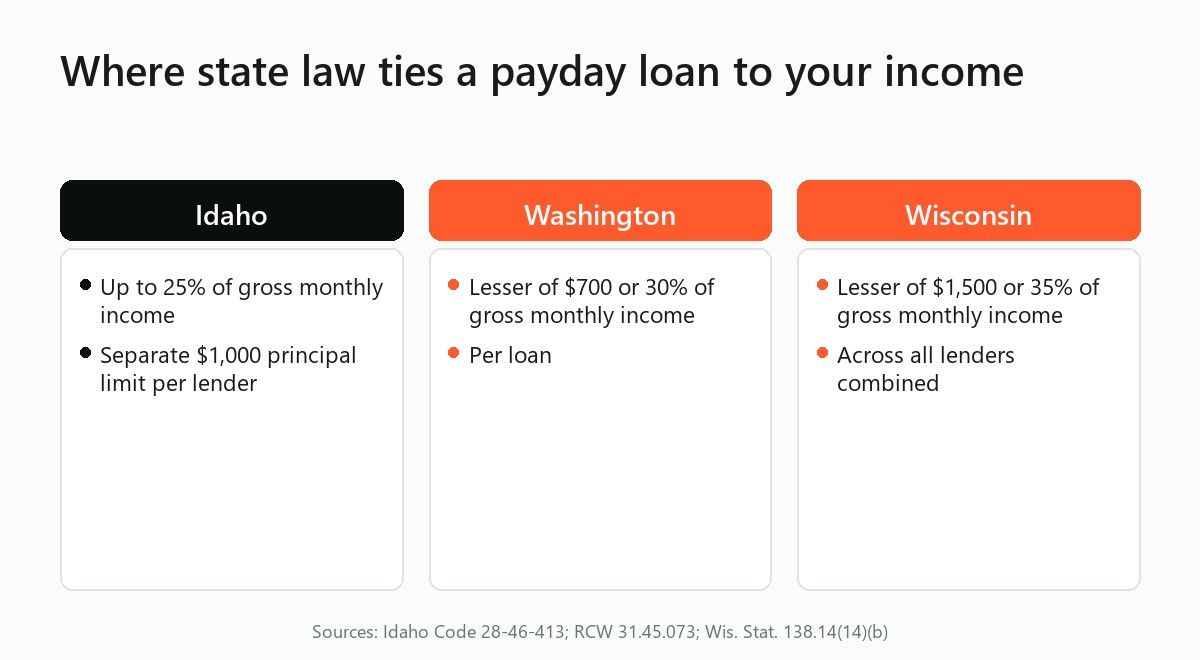
Idaho caps a payday loan at 25% of the borrower's gross monthly income at the time the loan is made. Idaho law states that a payday lender "shall not make a payday loan that exceeds twenty-five percent (25%) of the gross monthly income of the borrower when the loan is made" (Idaho Code section 28-46-413). Idaho also layers on a separate, flat aggregate limit: no single licensee can carry more than $1,000 plus fees in outstanding principal to one borrower, regardless of income.
That second rule functions as a backstop once the 25% figure would otherwise climb past it. Lenders in Idaho must obtain income information from the borrower at least once every 12 months, or the borrower can represent their income in writing.
Washington uses a "lesser of" formula written into the same statutory sentence. Under RCW 31.45.073, the maximum principal amount of a small loan "may not exceed seven hundred dollars or thirty percent of the gross monthly income of the borrower, whichever is lower." For more on how this plays out for Washington borrowers, including loan terms and fees, see our breakdown of Washington's 30%-of-income limit. The Washington Department of Financial Institutions publishes a consumer brochure stating the same $700/30% rule directly.
Wisconsin sets the highest percentage of the three, but also pairs it with the highest dollar backstop. State law bars a licensee from making a payday loan that would push a customer's outstanding aggregate liability, across principal, interest, and all other fees and charges to every licensee who has made payday loans to that customer, above "$1,500 or 35 percent of the customer's gross monthly income, whichever is less" (Wis. Stat. section 138.14(14)(b)).
A Wisconsin licensee may rely on a consumer report to verify the income figure used in that calculation. Notice the shape all three states share: below a certain income level, the percentage governs and your legal ceiling rises with your income; above that level, the flat dollar figure takes over and the ceiling stops moving no matter how much more you earn.
Maximum Payday Loan Amount by Income: The Math at Four Levels
Numbers make this concrete faster than formulas do, so here's what the same four gross monthly income figures produce in all three states.
- $2,000 a month: Idaho, 25% = $500, cap $500. Washington, 30% = $600, cap $600. Wisconsin, 35% = $700, cap $700.
- $3,000 a month: Idaho, 25% = $750, cap $750. Washington, 30% = $900, but the dollar cap binds, so the cap is $700. Wisconsin, 35% = $1,050, cap $1,050.
- $4,000 a month: Idaho, 25% = $1,000, which ties the dollar cap, so the cap is $1,000. Washington, 30% = $1,200, but the dollar cap binds, so the cap stays $700. Wisconsin, 35% = $1,400, cap $1,400.
- $5,000 a month: Idaho, 25% = $1,250, but the dollar cap binds, so the cap is $1,000. Washington, 30% = $1,500, but the dollar cap binds, so the cap stays $700. Wisconsin, 35% = $1,750, but the dollar cap binds, so the cap is $1,500.
Walk through what happens to a borrower in each state as income climbs. At $2,000 a month, the percentage formula does all the work everywhere: 25% of $2,000 is $500 in Idaho, 30% is $600 in Washington, 35% is $700 in Wisconsin. Every added dollar of income at this level raises the ceiling directly.
Push income up to $3,000, and Washington's dollar cap already kicks in. Thirty percent of $3,000 works out to $900, but the statute caps the loan at $700 regardless, because $700 is the lower figure. Idaho and Wisconsin borrowers still see their percentage formula in control at this income level: $750 in Idaho, $1,050 in Wisconsin.
At $4,000 a month, Idaho's flat backstop and its 25% figure land on the same number, $1,000, which is Idaho's crossover point. Above that income, the flat $1,000 cap governs. Washington's borrower is still stuck at $700, since 30% of $4,000 is $1,200, well above the dollar cap. Wisconsin's borrower, by contrast, is still climbing: 35% of $4,000 is $1,400, and Wisconsin's crossover doesn't arrive until roughly $4,286 a month.
By $5,000 a month, all three states have flipped to their flat dollar ceiling. Idaho tops out at $1,000, Washington at $700, Wisconsin at $1,500. In Wisconsin, a borrower earning $6,000 or $8,000 a month would still see that same $1,500 ceiling, since the statute caps total outstanding liability across every licensee and the percentage math has already been overtaken by the flat number. Washington's $700 is a per-loan principal limit under RCW 31.45.073, and Idaho's $1,000 figure is a separate per-licensee limit on outstanding principal, a different structure from Wisconsin's cap on total liability across all lenders.
That's the practical lesson buried in these formulas: past a certain income, "income-based" stops being about your income at all, and the flat dollar figure becomes the real answer. Wisconsin's cap is the highest of the three at every income level shown, topping out at $1,500 at $5,000 a month. Washington's is the lowest from $3,000 a month up, stuck at its $700 ceiling once income crosses the roughly $2,333 crossover point.
States That Cap the Dollar Amount Instead, or Don't Cap Size at All
Florida, Texas, and Illinois show three different approaches to the same problem.
In Florida, the statute sets a flat dollar ceiling that applies to every borrower regardless of income, alongside a 10% fee cap on the loan amount. That ceiling doesn't move whether you earn $2,000 a month or $8,000 a month; it's a fixed number written into state law. Our Florida payday loan laws page walks through how Florida's fee and size rules work together, including what that fee cap means for the loan's effective rate.
Texas effectively has no statewide loan-size cap for payday loans, income-based or otherwise. A licensing structure known as the Credit Access Business (CAB) model lets brokers arrange loans, and loan size in that structure scales with what the lender is willing to underwrite rather than with any statutory income formula. There's no dollar figure and no percentage-of-income rule doing that job in Texas.
Illinois took a different approach still: it caps the cost of the loan, not the size. Under the Predatory Loan Prevention Act, Illinois limits the all-in rate to a 36% Military Annual Percentage Rate (MAPR) equivalent, but it doesn't set a separate statutory loan-size or income-percentage limit. See our page on Illinois payday loan laws and the 36% APR cap explained for the full picture of how that rate cap works in practice.
One state fixes the dollar amount for everyone, one leaves size effectively open, and one regulates rate instead of size. None of them tie your maximum loan to a percentage of what you earn.
How Lenders Verify the Income Behind Your Offer
Whichever state you're in, a lender still needs to confirm the income figure it's using, whether that number feeds a statutory percentage formula or the lender's own internal underwriting. In Idaho and Wisconsin, the statutes specifically allow written borrower representation or consumer-report verification, which means the cap is only as accurate as the income figure the lender collects at the time of the loan. This is the heart of the payday loan income requirements question: the paperwork a lender asks for exists to pin down that one number, whether or not your state ties a legal ceiling to it. For the fuller mechanics of how lenders verify income generally, including paystubs, bank statements, and employment checks, see our guide to what lenders check before approving you.
Frequently Asked Questions
Does my state cap payday loans by a percentage of my income?
In Idaho, Washington, and Wisconsin, yes. Idaho caps a payday loan at 25% of gross monthly income, with a separate $1,000-plus-fees limit on any one licensee's outstanding principal. Washington caps at the lesser of $700 or 30% of gross monthly income, and Wisconsin caps at the lesser of $1,500 or 35% of gross monthly income. In Florida, Texas, and Illinois, this article's other verified examples, the state takes a different approach, such as a flat dollar cap or a rate cap, rather than a percentage-of-income formula; other states may use their own version of a flat cap, a rate cap, or no size cap at all.
What's the biggest payday loan I can get based on my paycheck?
It depends on both your income and your state's formula. In Idaho, the ceiling is the lesser of 25% of your gross monthly income or $1,000. In Washington, it's the lesser of 30% of your gross monthly income or $700. In Wisconsin, it's the lesser of 35% of your gross monthly income or $1,500.
Once your income crosses each state's specific threshold, the flat dollar figure becomes your real ceiling and further income increases stop raising it. In states without this kind of percentage-of-income formula, your maximum comes down to the lender's own underwriting plus whatever flat dollar cap or rate cap, if any, your state's law applies.
Is "income-based payday loan" a real, legally defined loan type?
Not as a distinct loan product. In Idaho, Washington, and Wisconsin, the phrase describes a real statutory formula that caps your loan at a percentage of gross monthly income. In states without a statutory income-percentage cap, the phrase describes standard lender underwriting practice, sizing an offer to your stated or verified income, without any state law requiring that specific formula.
Do lenders in these three states have to verify my income before applying the cap?
Idaho and Wisconsin's statutes both address income verification directly. Idaho requires lenders to obtain income information at least once every 12 months, or allows the borrower to represent their income in writing. Wisconsin allows a licensee to rely on a consumer report to verify the income figure used in its 35%/$1,500 calculation.