




It's 9 AM on payday. You check your banking app the way you always do, half out of habit, and the balance is exactly where it was yesterday.
No deposit. You refresh. Still nothing.
Your mind starts running through the bills due this week: rent, the car payment, maybe an autopay that's about to bounce. That jolt of panic is normal, and it's also usually premature. If you didn't get paid on payday and your direct deposit isn't there, the most likely explanation is a timing issue or a fixable error somewhere in the chain.
Here's the plan for working through it over the next two days, step by step, so you know exactly who to check with and in what order.
Step 1: In the First 30 Minutes, Rule Out the Easy Explanations
Start with the boring stuff. It solves more of these situations than people expect.
First, check the actual time. Direct deposit through the ACH (Automated Clearing House) network settles in batches at fixed windows the Federal Reserve runs throughout the day.
Items submitted by 10:30 AM ET settle by 1:00 PM ET, items submitted by 2:45 PM ET settle by 5:00 PM ET, and items submitted by 4:45 PM ET settle by 6:00 PM ET the same business day, according to the Federal Reserve's FedACH processing schedule. If your employer's payroll file was submitted for a later window, your money can still be sitting in the pipeline at 9 AM even though everything on their end was done correctly.
Some payroll runs are also submitted as future-dated credits, which the Federal Reserve settles at 8:30 AM ET on the scheduled date, so a slight gap between "scheduled" and "visible in your account" is normal (Federal Reserve Financial Services, FedACH Processing Schedule). An empty balance at breakfast often just means the batch carrying your pay hasn't cleared yet.
Second, check your bank details on file with your employer, especially if you're new to the job or recently switched banks. A single wrong digit in a routing or account number will send a deposit nowhere, and it's the fastest thing to rule out before you call anyone else.
Third, look for a pending or processing transaction rather than assuming there's nothing at all. Some banks post incoming ACH credits as pending before the funds are available. Also note that ACH doesn't process on weekends or federal holidays, so if payday lands on or right after one, a routine one-day delay is common and doesn't necessarily point to a problem.
One more thing worth knowing: the size of your bank plays a role here too. Pay can post at different times of day depending on whether you bank with a large national institution or a smaller bank or credit union, simply because of when that institution processes its incoming ACH batches. If your coworker at a different bank already has their deposit and you don't, that alone isn't proof anything went wrong on your end.
Step 2: Figure Out Why Your Direct Deposit Is Late
If you've checked the time, your account details, and your pending transactions and you're still empty-handed, it's time to triage. There are really only three places this can be stuck: your employer, the payroll processor, or your bank. Knowing which one narrows down exactly who to call next.
- The employer: The payroll file was never transmitted, or it was submitted late. This is often a one-time human error, the kind that gets fixed with a quick resubmission once someone notices. A useful sign: if coworkers on the same pay schedule are also missing their deposit, the problem is almost certainly upstream at the company.
- The payroll processor: The file was submitted by your employer but missed a settlement window, or it hit a bank holiday that pushed processing back a day. A missed window usually means a later same-day settlement; a holiday usually means a one-day delay.
- The bank: Funds were received through ACH but haven't been released or posted to your available balance yet. This is worth confirming directly with your bank's support line, since a hold on an incoming credit looks identical to "nothing arrived" from where you're sitting.
Call your HR or payroll contact first. Ask a specific question: was payroll submitted for this pay period, and on what date and time? That single answer usually tells you whether you're waiting on a batch already in motion or dealing with something that needs to be fixed and resubmitted. If payroll confirms the file went out on time, your next call is to your bank.
Step 3: What the Law Actually Says (and What It Doesn't)
Here's a myth worth clearing up early, because it shapes how urgently you should act. There is no federal law that requires your employer to pay you within a specific number of days of payday. The Fair Labor Standards Act governs minimum wage and overtime calculations, but it does not set payday timing rules.
The Department of Labor's Wage and Hour Division state payday requirements page publishes a state-by-state reference specifically because payday frequency and timing are governed at the state level, and it directs workers to their state labor office for official information.
That means your actual rights depend entirely on which state you work in. Two examples show how differently states handle this.
California requires wages earned between the 1st and 15th of the month to be paid between the 16th and 26th, and wages earned from the 16th through the end of the month to be paid by the 10th of the following month, under Labor Code Section 204. If an employer pays late, Labor Code Section 210 sets a penalty of $100 per employee for a first violation, and $200 per employee plus 25 percent of the wages unlawfully withheld for a subsequent or willful violation, according to the California Department of Industrial Relations' late payment of wages guidance.
New York requires manual workers to be paid weekly, no later than seven calendar days after the end of the week in which the wages were earned, under Labor Law Section 191(1)(a).
Those two examples prove that state rules can be specific and enforceable. Your own state's rule could look nothing like either one. If you're not in California or New York, check your state's specific rule through the DOL's state payday reference before assuming anything about penalties or timelines.
Step 4: Cover the Gap Without Reaching for a Payday Loan
While you're waiting on payroll or your bank to sort things out, the bills on your calendar don't pause. Here's the order I'd work through, starting with the option that costs you nothing.
Call your billers early, while the due date is still ahead of you. Rent, utilities, and auto loans often have a grace period or a one-time skip-payment option if you ask before the due date instead of after. A short, honest call explaining that your paycheck is delayed, with the date you expect to be paid, goes a long way toward keeping a late fee off your account.
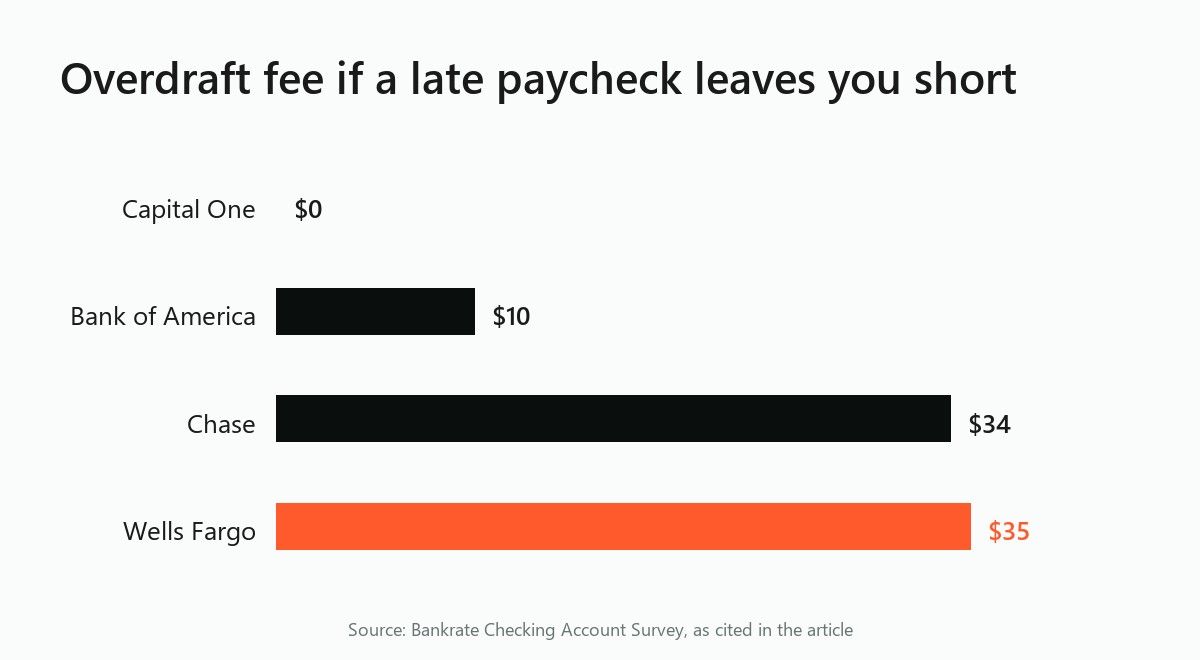
Check whether your bank has a low-fee or no-fee overdraft option. The gap between banks here is significant: Capital One charges $0 for overdrafts, a policy in place since January 2022; Bank of America charges $10, cut down from $35, with NSF fees eliminated in February 2022; Chase charges $34; and Wells Fargo charges $35 (Bankrate, Checking Account Survey). The average overdraft fee across banks sits around $26.77 (Bankrate, Checking Account Survey).
If you're not sure what your own bank charges, a quick look now can keep a small shortfall from turning into a fee that makes things worse. This is exactly the gap a no-overdraft-fee checking account is built to close, and comparing accounts is a reasonable next step if this isn't the first time a fee like this has caught you off guard.
Consider an employer pay advance or a low-cost earned wage access option, but only the free or employer-sponsored kind. Some employers offer an advance on wages already earned. Payactiv, one earned wage access provider, charges little when tied to your actual direct deposit: as of the CFPB's 2020 approval order, Payactiv charged a $1.99 expedited-transfer fee that was waived with a qualifying direct deposit.
Treat the fee-based instant-transfer versions of these products with caution. The CFPB has calculated APR-equivalents on earned wage access fees ranging from roughly 109.5 percent (on a $106 advance repaid in 10 days) up to 580.4 percent (on a $50 advance repaid in 4 days) when a fee is charged. Take the free option if it's on the table before you take the fast one.
Notice what's missing from that list: a payday loan. A short delay in a paycheck you know is coming is exactly the kind of situation people get talked into a payday loan for, and it's exactly the situation where you don't need one. If these first three steps don't fully close the gap, read through these payday loan alternatives before considering a high-cost option. A credit union PAL loan is a far cheaper fallback than a storefront payday lender if you truly need to borrow.
Step 5: If It's Still Not Resolved After 48 Hours
Most of these situations clear up within hours, sometimes by the next morning. If two full business days have passed and you still don't have your money, it's time to escalate.
Put your request in writing to HR or payroll. Ask directly when the wages will be paid and reference the pay period in question. A written record matters if this needs to go further.
If your employer still hasn't resolved it, contact your state's labor agency. The DOL's state payday requirements page is the right starting point for finding your state's specific office and process. Filing a wage claim is a real option. California, for example, sets per-employee penalties for late pay under Labor Code Section 210; check your own state's rule through the DOL page.
Build a Buffer So This Doesn't Catch You Again
A delayed paycheck stings more when your budget has zero room to absorb it. If this scare taught you anything, let it be this: even a small cash cushion changes how a day like today feels. You go from panicking about rent to just being mildly annoyed at your bank.
If your income is irregular, tipped, or hourly and a traditional monthly budget has never quite fit your paychecks, it's worth building a system designed around how your money actually arrives, week to week, rather than treating every paycheck as identical.
Your next step this week: open your banking app and check your last three paychecks for the exact time they landed. If you notice a pattern, like deposits consistently posting mid-afternoon instead of first thing in the morning, that's useful information for the next time a payday feels late and isn't. And if you don't already have even a small buffer set aside, this is the week to start one.
Frequently Asked Questions
How long can a direct deposit be late before I should worry?
ACH settles same-day in batches as late as 6:00 PM ET, so a deposit can still be in transit hours after you expected it. Weekends and holidays add a business day. If nothing has arrived by the end of the next business day, contact payroll in writing; California and New York set their own pay-timing deadlines.
Does federal law require employers to pay by a certain time on payday?
No. The Fair Labor Standards Act covers minimum wage and overtime, not payday timing. Payday frequency and timing rules are set state by state, which is why the Department of Labor directs workers to their state labor office for the specific rule that applies to them.
What's the difference between a delay caused by my employer, the payroll processor, and my bank?
An employer-side delay means the payroll file was never transmitted or was late. A processor-side delay means the file went out but missed a settlement window or hit a holiday. A bank-side delay means the funds arrived but haven't posted yet. Confirming with your employer whether the file was submitted, and when, tells you which one you're dealing with.
Should I take out a payday loan while I wait for my paycheck?
No. A payday loan is a high-cost way to cover a gap that's usually resolved within a day or two once you work through the triage steps. Try calling your billers for a grace period, checking your bank's overdraft policy, or using a free employer-sponsored pay advance first.
What should I do if my employer still hasn't paid me after 48 hours?
Put your request in writing to HR or payroll, then contact your state's labor agency if it's still unresolved. The DOL's state payday requirements page can point you to the right state office, and filing a wage claim is an option if your state's law has been violated.