




Under Georgia payday loan laws, payday loans are illegal in the state, full stop, with no rate cap that makes them legal at a price. The Georgia Department of Banking and Finance says it plainly on its own site: "payday lending is illegal in Georgia."
The statute behind that statement, O.C.G.A. § 16-17-2, sits in Chapter 17 of Title 16, the title covering crimes and offenses, rather than Title 7, which covers banking. That placement matters.
Georgia didn't cap payday rates. It wrote a criminal ban, and it built in a felony enhancement for lenders who keep at it after getting caught. That's a meaningfully different regulatory posture than a fee schedule, and it changes how a lender who ignores it should expect to be treated.
If you're a Georgia resident who got a text or an email offering an "online payday loan" or a "cash advance," here's what the law actually says, what happens to the lender if they're caught, what the legal small-loan alternatives look like, and what you should do next.
What O.C.G.A. § 16-17-2 Actually Prohibits
The Payday Lending Act, in force since 2004, prohibits loan transactions of $3,000 or less made in violation of the chapter, which in practice covers short-term, high-cost lending structured as a payday loan, check-cashing advance, or similar product, subject to statutory exceptions for state-chartered or licensed lenders (FindLaw mirror of O.C.G.A. § 16-17-2; Georgia DBF). A loan made in violation of the chapter is void, meaning a Georgia court will not enforce repayment of principal or interest on it. The DBF states that directly on its payday lending page.
Note the dollar threshold: the ban covers loan transactions of $3,000 or less, which is exactly the size of loan a payday or cash-advance product is built around. Two penalty tiers apply above that ban, and they don't blend together the way some summaries suggest.
A first offense is a misdemeanor of a high and aggravated nature: up to one year in jail, a fine of up to $5,000, or both. Each loan transaction counts as its own separate violation, so a lender that made fifty illegal loans faces fifty separate counts (FindLaw mirror of O.C.G.A. § 16-17-2).
The felony enhancement only kicks in after three prior convictions under the same subsections. Once a lender has three convictions on the books, every conviction after that is a felony: up to five years in prison, a fine of up to $10,000, or both (FindLaw mirror of O.C.G.A. § 16-17-2). A first-time violator does not face felony exposure.
A repeat operator, caught again after three strikes, does. That distinction gets flattened in some coverage of this statute, and it shouldn't. It changes how serious a first-time lender's exposure actually is compared to a lender who has already been convicted and keeps operating anyway.
If you want to see how a typical payday loan is structured in a state that allows the product, our breakdown of how a typical payday loan is structured walks through the mechanics, along with why a $15-per-$100 fee equals a 391% APR in states that permit it. Georgia's answer to that math was to ban the product rather than cap it.
Why Georgia Has No Payday Storefronts: The Georgia Installment Loan Act
Because payday lending is a crime here, the state's small-dollar credit market runs through a different statute entirely: the Georgia Installment Loan Act, O.C.G.A. §§ 7-3-1 through 7-3-52. It was renamed from the Georgia Industrial Loan Act, effective June 30, 2020, but the licensing structure it governs, loans of $3,000 or less made by lenders licensed through the Georgia Department of Banking and Finance, is the same product line (Georgia DBF).
Read the fee structure carefully, because the headline interest figure is not the full cost of the loan.
- Interest is capped at not more than 10% per annum of the face amount of the contract, under § 7-3-14(1) (O.C.G.A. § 7-3-14, Justia mirror).
- On top of that, lenders may charge a one-time loan fee at origination: up to 8% of the first $600 of the loan's face amount, plus 4% of any amount above $600. That fee cannot be charged again on a refinanced balance repaid to the same lender within the prior six months, or within two months if the balance is $300 or less (Justia mirror of O.C.G.A. § 7-3-11).
- A monthly maintenance charge of $3.00 applies for the term of the loan contract (Justia mirror of O.C.G.A. § 7-3-11).
The 10% figure is interest only. Stack the origination fee and the $3 monthly maintenance charge on top of it, and the real cost of a licensed Georgia installment loan runs above that 10% number.
Separately, the DBF warns on its own site that "the maximum interest rates allowed under the law may be significantly higher than what is being offered in the market" (Georgia DBF). That means the statutory maximum can run higher than what a given lender actually charges, so it pays to compare the fee-inclusive cost of an actual quote rather than assuming the 10% ceiling is the price you'll pay.
Georgia Title Pawn Laws: The Legal High-Cost Product That Filled the Gap
In Georgia, the high-cost product left standing is the title pawn, governed by O.C.G.A. § 44-12-131 under Title 44's pawn transaction rules.
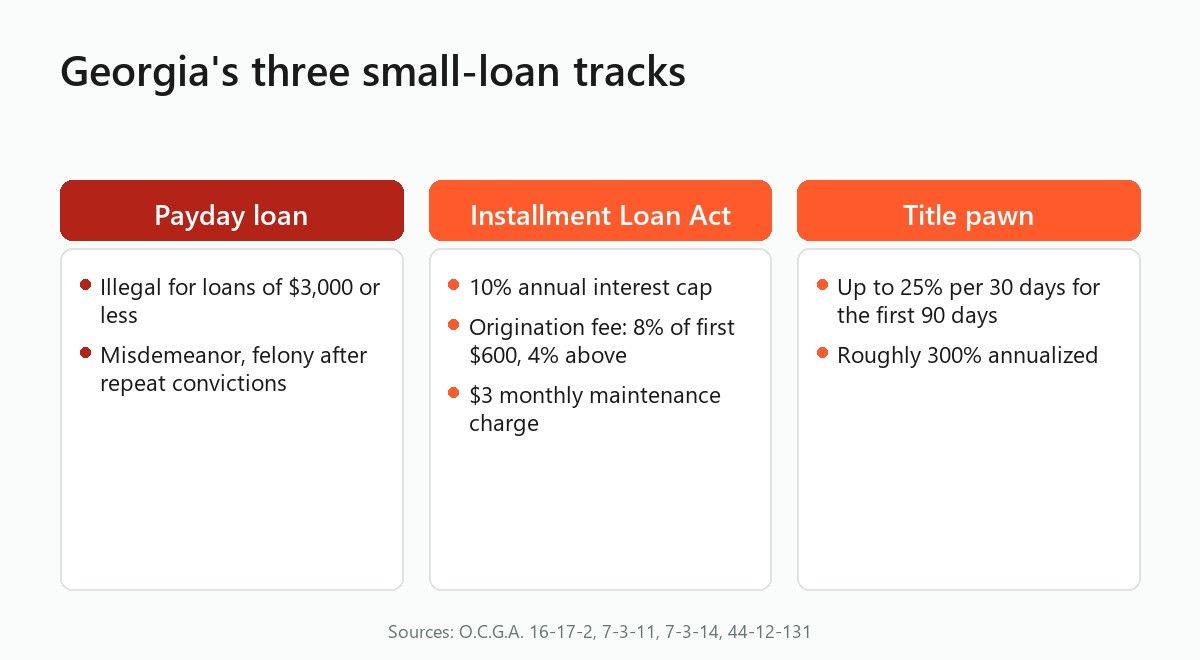
A licensed pawnbroker taking a vehicle title as collateral can charge, for the first 90 days of the pawn, interest and pawnshop charges together up to 25% of the principal per 30-day period, with a minimum charge of up to $10 per period. Annualized, that works out to roughly 300%. If the pawn continues past 90 days, the rate drops to 12.5% of principal per 30-day period, with a minimum charge of up to $5 per period, or roughly 150% annualized. A motor-vehicle title pawn can also carry a storage fee of up to $5.00 per day (Georgia AG Consumer Protection Division, Title Pawns and Cash Advances).
The Georgia AG's Consumer Protection Division puts the combined effect at a maximum yearly rate around 187.5%. Georgia law requires title pawn lenders to warn borrowers up front that failing to repay can mean losing the vehicle, according to the AG's page on title pawns (Georgia AG, Title Pawns and Cash Advances). That warning isn't boilerplate.
Nationally, according to the CFPB, roughly one in five auto title-loan borrowers has their vehicle seized after failing to repay. Georgia's title pawn structure carries the same kind of repossession risk, and it's the legal product that sits where a payday loan would otherwise be in this state's credit market.
Line the three products up and the state's small-dollar credit ladder becomes easy to see. A payday loan is a crime from the first transaction. An Installment Loan Act loan is licensed, capped at 10% annual interest, and layered with the origination fee and monthly charge described above. A title pawn is licensed too, but priced far higher, and it puts a borrower's vehicle on the line in a way neither of the other two products does.
Knowing which rung of that ladder a lender is standing on tells you what questions to ask before you sign. A licensed Installment Loan Act lender should be able to show you its DBF license and break out the interest, the origination fee, and the monthly maintenance charge as separate line items. A title pawn lender should disclose the repossession terms up front. A lender that will not do either of those things, or that will not name the statute it operates under, is worth walking away from.
If an Online or Out-of-State Lender Approaches You
This is the part that trips people up. A website that looks legitimate, offers "guaranteed approval," and asks for your bank account or debit card number for an ACH withdrawal doesn't become legal just because it operates from another state or claims a tribal affiliation.
Georgia's ban applies based on where the borrower is located, not where the lender is incorporated or headquartered. The statute's language governs loan transactions reaching Georgia residents, and the DBF's own statement that "payday lending is illegal in Georgia" doesn't carve out an exception for online lenders.
Structuring around the law through a tribal lending entity isn't a defense either. In Western Sky Financial, LLC v. State of Georgia, tribal-lender immunity did not shield a payday lender from Georgia's ban, and loans made in violation of the chapter are void regardless of how the lender is organized.
If you're already dealing with one of these lenders, here's what actually helps:
- Contact your bank directly to revoke the ACH authorization, in writing so you have a paper trail.
- Keep every piece of communication: the loan agreement, texts, emails, and any payment record. Screenshots count.
- Notify the Georgia Department of Banking and Finance and file a complaint with the Georgia Attorney General's Consumer Protection Division, the CFPB, and the FTC.
- Because this is a criminal statute, enforcement runs through county solicitors or district attorneys, not through DBF directly. A local solicitor's office, or the district attorney's office where there's no solicitor, is where a criminal referral against the lender would go.
You don't need to feel obligated to keep paying a lender operating outside Georgia law. A loan made in violation of the chapter is void under the statute itself. Because DBF doesn't prosecute the criminal statute directly, the county solicitor or district attorney's office is the body with authority to bring charges against the lender.
That said, talk to a Georgia consumer attorney or legal aid office about your specific loan before you stop payment. Your exact situation, how the loan was structured, what you signed, whether a state-licensed exception might apply, changes the practical steps you should take. Keeping your documentation organized before that conversation, the loan agreement, the payment history, and any correspondence with the lender, makes that first call faster and more useful.
Legal Alternatives Worth Trying First
Before signing anything from an online lender promising fast cash, look at what's actually licensed and available in Georgia. A credit union PAL loan is structured under National Credit Union Administration rules. It's worth checking whether you qualify for credit union membership, and comparing that option against any DBF-licensed installment loan offer, before you consider a title pawn.
If you're trying to figure out whether an offer you received is even legitimate, our guide to common payday loan scam patterns covers the ACH-access requests and "guaranteed approval" pressure tactics that show up with these offers. And if a lender has already crossed a line, our walkthrough of filing a federal complaint covers the CFPB process step by step.
Not every small-dollar option in Georgia is expensive by definition. Compare a DBF-licensed offer against a credit union PAL loan before you sign anything, ask each lender to show its interest, its origination fee, and its monthly charge as separate numbers, and treat any lender that won't break those out as a lender you should not be doing business with.
Frequently Asked Questions
Is it illegal to get a payday loan in Georgia?
Yes. Georgia's Payday Lending Act, O.C.G.A. § 16-17-2, bans loan transactions of $3,000 or less structured as payday loans, check-cashing advances, or similar products, subject to narrow statutory exceptions for licensed lenders. The Georgia Department of Banking and Finance states directly that payday lending is illegal in the state.
Can an online payday lender still collect from a Georgia resident?
The law applies based on where the borrower is located, not where the lender is based, and a loan made in violation of the chapter is void. Tribal-lender status is not a defense either, as established in Western Sky Financial, LLC v. State of Georgia.
What's the difference between a title pawn and a payday loan in Georgia?
A payday loan is banned outright under O.C.G.A. § 16-17-2. A title pawn is a legal, licensed product under O.C.G.A. § 44-12-131 that uses a vehicle title as collateral.
It charges up to 25% of principal per 30-day period for the first 90 days, roughly 300% annualized, dropping to 12.5% per period after that. Nonpayment risks losing the vehicle.
What penalty does a lender face for making an illegal payday loan in Georgia?
A first violation is a misdemeanor of a high and aggravated nature: up to one year in jail, a fine of up to $5,000, or both, with each loan a separate count. After three prior convictions, the felony enhancement applies: up to five years in prison, a fine of up to $10,000, or both.
What should I do if I already took out an illegal payday loan in Georgia?
Talk to a consumer attorney about your specific loan first. Beyond that, revoke ACH authorization with your bank, keep records of the loan and any lender communication, and file complaints with the Georgia DBF, the AG's Consumer Protection Division, the CFPB, and the FTC. Because this is a criminal statute, a referral goes through your county solicitor or district attorney.