




If a mailer, an online ad, or someone in your unit has offered you a "federal allotment loan," the pitch usually goes something like this: sign up, the payment comes straight out of your paycheck before you ever see it, and you never have to think about it again. That last part is exactly what should make you pause. An allotment loan is an ordinary installment loan, sometimes a good one, sometimes not, repaid through a payroll allotment. The rules governing that allotment come from two very different regulators depending on whether you're a civilian federal employee or a service member, and knowing which rulebook applies to you is what separates a routine offer from a problem worth catching before you sign.
What a Federal Allotment Loan Actually Is
An allotment is a standing instruction to your payroll system to divert part of your pay to a third party before the rest lands in your bank account. Federal civilian employees have allotments processed through their agency's payroll provider. Active-duty service members have allotments processed through the Defense Finance and Accounting Service, or DFAS. Lenders who market "allotment loans" to this audience are betting that a payment taken directly from payroll feels safer, both to the borrower and to the lender's own risk model, than an ordinary ACH draft from a checking account.
That feeling captures part of the picture, but the rules that govern what an allotment can be used for, and whether a lender can force you into one, come from two separate rulebooks.
Civilian Federal Employees: What OPM Allows Under 5 CFR 550.311
If you're a civilian federal employee, your allotments are governed by Title 5 of the Code of Federal Regulations, Part 550, Subpart C, "Allotments From Federal Employees" (5 CFR 550.311). Under this rule, an agency head may permit a discretionary allotment "for any legal purpose deemed appropriate by the head of the agency," and the agency can cap how many discretionary allotments an employee is allowed to run at once. The regulation also sets baseline limits that apply across the board: you have to specifically name the allottee and the amount, your total allotments can't exceed the pay due for that period, and only you, the employee, can authorize a change or a cancellation.
What this means in practice is that the Office of Personnel Management does not set a blanket, government-wide list of what a civilian allotment can or cannot pay for. Your own agency sets that boundary. That's a meaningful contrast to what service members face: a civilian federal employee does not have the same "no personal property" restriction the Department of Defense put on military allotments in 2015.
Service Members: DFAS Allotment Rules and the January 1, 2015 DoD Restriction
If you're active-duty military, your pay allotments run through DFAS, and the rules changed in a way that still shapes this market today. Effective January 1, 2015, the Department of Defense stopped allowing new discretionary military-pay allotments to be set up for "the purchase, lease, or rental of personal property." Anyone starting a new allotment now has to certify, under the Uniform Code of Military Justice, that it isn't for that purpose.
The restriction covers tangible, movable consumer goods, including cars, boats, motorcycles, appliances, furniture, electronics, and cellphones. Allotments that already existed before the rule took effect were grandfathered in and left alone.
This was a change to the DoD's Financial Management Regulation, not a provision written into a defense authorization bill. The Secretary of Defense at the time, Chuck Hagel, directed the change following an interagency review that began in June 2013, in response to a major CFPB enforcement action, and the department publicized it through a Federal Register notice dated December 2014. The official DoD news distribution service, DVIDS, and the Army's official site both confirm the same effective date and scope.
Allotments are still allowed for savings and investment accounts, dependent support, insurance premiums, mortgage and rent payments, charitable giving, and repayment of debts owed to the government. What changed is narrower than that list makes it sound: it closed off allotments as a financing tool for consumer goods.
One scope note, because it trips people up: this restriction applies to active-duty pay allotments. It does not apply to military retirees, and it does not apply to DoD civilian employees, whose allotments fall under the OPM rule above rather than the DoD Financial Management Regulation.
If You're Active Duty: The 36% MAPR Cap and Why a Lender Can't Force an Allotment
An active-duty service member or a covered dependent gets a second layer of protection on top of the allotment rules: the Military Lending Act. The short version is that the MLA caps the Military Annual Percentage Rate at 36% on covered consumer credit extended to covered borrowers. Our deeper explainer on how the Military Lending Act's 36% cap works covers the full civilian-versus-active-duty mechanics, so we won't re-tread that ground here.
What matters specifically for allotment loans is a separate MLA protection that gets far less attention: a creditor cannot require a covered borrower to repay by military allotment as a condition of getting the loan. A lender can accept a voluntary allotment, and some borrowers choose one for convenience. But convenience and a mandatory condition are two different things, and a lender that makes allotment repayment a condition of approval is crossing a line the CFPB has already enforced.
Lenders favor allotment repayment for a simple reason: DFAS pays them before you ever see the money, which makes allotment repayment low-risk for the lender.
What These Loans Actually Cost
Because "allotment loan" describes a repayment method, not a product type, cost varies a lot by lender, and there's no single verified "typical" APR for the category as a whole. What's useful instead is looking at two real, named examples that sit at opposite ends of how transparent this market can be.
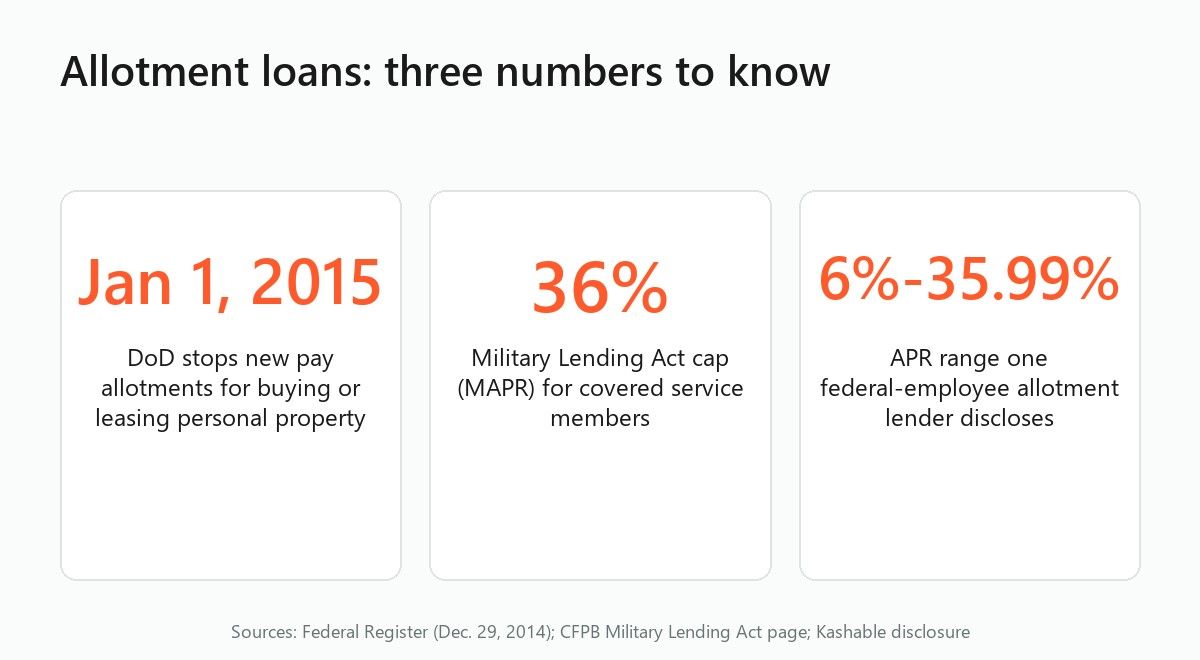
Kashable, a fintech lender that markets specifically to federal and public-sector employees, discloses APRs of 6% to 35.99%, loan amounts from $500 to $30,000, and terms of 6 to 36 months, funded and repaid through payroll allotment, with no hidden fees and no prepayment penalty stated on its own site. Treat those numbers as the lender's own disclosure rather than an independently audited figure, but the range itself, and the fact that it's published up front, is the point worth noticing.
federalemployeeloans.com, by contrast, offers loans of $500 to $3,000 over 6 or 12 months with no-late-fee payroll deduction, but does not publish an APR on its rates page. The exact rate is disclosed only after you apply, which is standard under the Truth in Lending Act, but it means you're deciding whether to start an application before you know the real cost of the loan. A lender that won't put an APR in front of you before you apply is not automatically running a scam. It is a reason to ask for the number in writing before you sign anything, and to walk away if the lender won't give it to you.
APRs on allotment-repaid loans run the gamut, from single digits at reputable fintech lenders to the 36% MAPR ceiling that applies only to MLA-covered military borrowers, not to civilian federal employees. That spread is wide enough that the APR itself, not the payroll-deduction feature, should decide whether a given offer is worth taking. The convenience of automatic payroll repayment is the same at every price point; only the APR tells you whether you're getting a fair deal or an expensive one.
Red Flags: What the Omni Financial Case Teaches
The clearest picture of how allotment lending goes wrong comes from a real enforcement action. In December 2020, the CFPB settled with Omni Financial of Nevada, Inc., a lender that made installment loans to active-duty service members and their dependents. The CFPB alleged that, starting in October 2016, Omni required borrowers covered by the MLA to repay by military allotment as a condition of getting the loan, which violates the MLA's ban on mandatory allotment repayment described above. The CFPB separately alleged that Omni violated the Electronic Fund Transfer Act by requiring preauthorized ACH withdrawals as a loan condition.
Loans in the case ranged from $500 to $10,000. Omni paid a $2.175 million civil penalty and was barred from using allotment-repayment rates as a factor in employee performance evaluations. Two of the warning signs below come straight out of that case, and the rest are worth watching for regardless:
- The lender tells you an allotment, or automatic payroll deduction, is required to qualify, rather than offered as an option. This is the exact violation the CFPB cited against Omni.
- A loan officer pushes hard for allotment repayment. In the Omni case, the CFPB barred the lender from using allotment-repayment rates in employee performance evaluations, the incentive behind that kind of pressure.
- A third-party payment processor adds a fee you weren't told about up front. The CFPB's own allotment guidance notes that third-party processors sometimes add fees an ordinary automatic payment wouldn't carry.
- Nobody will give you an APR in writing before you apply or sign. Ask for it before you sign anything, and treat a lender that won't provide one as a reason to walk away.
The CFPB's own consumer guidance captures why this matters: allotment repayment feels automatic and safe because DFAS pays the lender before your bank ever sees the money, but that same feature makes a billing dispute or an overpayment much harder to unwind than an ordinary automatic payment from your checking account. If something goes wrong, you're not just disputing a charge. You're trying to unwind a payroll deduction.
What to Do If a Lender Broke the Rules
A lender who required allotment repayment as a condition of your loan, or any lender matching the red flags above, is worth reporting. Active-duty MLA violations and general consumer-lending violations both fall within the CFPB's jurisdiction, and the agency's Omni Financial case shows it acts on exactly this fact pattern. Our guide on how to file a complaint with the CFPB walks through what to gather and how to submit it. Keep your loan agreement, any allotment authorization paperwork, and copies of anything a loan officer told you about the allotment being required.
Cheaper Alternatives Worth Checking First
Before signing anything with an undisclosed APR, it's worth checking what a credit union can offer. Federal credit unions can issue Payday Alternative Loans with a capped APR; our breakdown of a credit union PAL loan covers eligibility and how the caps work. For a broader survey of options before committing to any payroll-deduction product, our roundup of lower-cost alternatives is a good next stop. And for anyone already renewing a high-cost loan while an allotment lender offers to "help" by consolidating it, our guide on how to get out of a rollover cycle is worth reading before adding a new payroll deduction on top of an old one.
Frequently Asked Questions
Is a federal allotment loan the same thing as a payday loan?
No. An allotment loan is an installment loan repaid through a payroll deduction rather than a post-dated check or ACH draft. The repayment method differs, but the cost still depends entirely on the individual lender's APR and fees, which can range from reasonable to predatory.
Can a lender require me to repay by allotment to get the loan?
If you're a covered borrower under the Military Lending Act, generally an active-duty service member or a covered dependent, a creditor cannot make allotment repayment a condition of the loan. A lender can accept a voluntary allotment, but requiring one is the violation the CFPB cited in its 2020 Omni Financial of Nevada enforcement action.
What changed with military allotments in 2015?
Effective January 1, 2015, the DoD stopped allowing new discretionary military-pay allotments to fund the purchase, lease, or rental of personal property, such as vehicles, electronics, or furniture. It was a change to the DoD's Financial Management Regulation, publicized through a December 2014 Federal Register notice. Allotments set up before the change were grandfathered in.
Do civilian federal employees face the same allotment restrictions as service members?
No. Civilian federal employees' allotments are governed by 5 CFR 550.311, which lets each agency head decide what discretionary allotments can be used for. There is no government-wide ban on using a civilian allotment for personal property purchases the way there is for active-duty military pay allotments.
How do I know if an allotment lender's APR is fair?
Ask for the APR in writing before you apply, not after. If you're MLA-covered, the legal ceiling is 36% MAPR, and Kashable's published federal-employee range of 6% to 35.99% offers a real benchmark. A lender that stalls on disclosing an APR is a reason to compare the offer against a credit union PAL loan first.