


In December 2006, Washington's Department of Financial Institutions closed the books on an investigation into Check 'n Go of Washington, Inc. The findings: the company had required borrowers to write multiple checks to secure a single loan, charged fees above what the state allowed, and collected personal identification numbers without consent. The case ended in a fine and restitution order detailed further below. That settlement is nearly two decades old now, but it's the kind of document that tells you more about a lender than any five-star review can.
If you're weighing Check 'n Go payday loans against a storefront ad or a search result in front of you, this review leans on what regulators have actually documented, not a generic APR range pulled from a third-party aggregator, and says so plainly wherever the current-day fee data wasn't independently verifiable.
What Check 'n Go Offers, State by State
Check 'n Go is a multi-state consumer lender offering single-payment payday loans, installment loans, and in some states a line of credit product. What you're offered depends entirely on where you live, because state law dictates the product mix a payday-style lender can legally sell there. A borrower in Michigan and a borrower in California are not being offered the same product, even if both call it a "Check 'n Go loan."
As of this article's publish date, Check 'n Go lists online lending availability in Alabama, California, Delaware, Florida, Idaho, Indiana, Kansas, Michigan, Missouri, Oklahoma, South Carolina, Texas, Utah, and Wisconsin. Storefront locations appear in most of those same states, with California, Florida, Indiana, and Kansas operating online-only.
Lender footprints shift as state laws and business decisions change. Confirm current product availability on Check 'n Go's own state-selector page before you apply, rather than trusting a list frozen at the moment this was written. The company does not appear to operate in states with payday-lending bans or strict rate caps.
Storefront Versus Online: What Actually Changes
The product name stays the same. The process doesn't.
A storefront application puts a person across the counter from you, someone you can ask directly if a line in the disclosure doesn't make sense. Four of the states Check 'n Go serves, California, Florida, Indiana, and Kansas, are online-only, so that in-person option isn't available everywhere.
An online application skips that conversation entirely. You're reading the disclosure on your own, with no one to ask before you e-sign it. The site's comparison of online and storefront lending covers that cost difference in more depth.
The Texas Wrinkle: Why Check 'n Go Isn't a Direct Lender There
In Texas, Check 'n Go doesn't lend you money directly. It operates as a Credit Services Organization, registered with the Texas Secretary of State, functioning as a Credit Access Business under state law. The actual loan comes from an unaffiliated third-party lender at a nominal rate of 10% per year, the rate Texas caps direct lenders to.
Check 'n Go's revenue comes from a separate CSO or CAB fee layered on top of that loan, a fee that isn't subject to the same interest-rate ceiling. Texas's own regulator describes the arrangement plainly: credit access businesses obtain credit for a consumer from an independent third-party lender, and the credit access business charges a fee to the consumer for obtaining that third-party loan, per the Texas Office of Consumer Credit Commissioner's own description of credit access businesses. That's Texas's CAB fee loophole in a sentence, and it's worth understanding before you sign anything in Texas, because the total cost of borrowing runs through that CSO fee, not the advertised 10% rate.
Ask the storefront employee, or check the disclosure, for both the loan's stated interest rate and the separate CSO fee before you compare Check 'n Go's total cost to any other state's pricing.
Check 'n Go Rates and Fees: What Could Be Confirmed in California
California is the other state where Check 'n Go's history is worth knowing before you apply, because it's the site of the larger of its two documented settlements, covered in the regulatory history section below. The company's California entity currently operates under a California Deferred Deposit Transaction Law license, the state's payday-lending licensing framework, put in place after a rent-a-bank arrangement the company used in the 2000s came under legal fire.
Check 'n Go's California fee schedule was not publicly confirmable for this review; the company's site did not load during research, and no independently verifiable rate figure could be sourced. Rather than repeat a number this review could not confirm firsthand, the honest answer is: ask for the exact APR and finance charge before you sign, and treat California's rate cap as background on what the state law actually permits.
That's a gap in this review, not a claim that Check 'n Go hides its pricing; the company does publish state-specific fee schedules on its own site, this review's automated tools simply couldn't load them. Pull up your own state's schedule directly on checkngo.com and read the total finance charge before you apply, so you're comparing the actual number rather than a range from somewhere else.
Regulatory and Legal History
Two enforcement actions against Check 'n Go carry enough documentation to cite with confidence: dollar figures, dates, and named regulators attached.
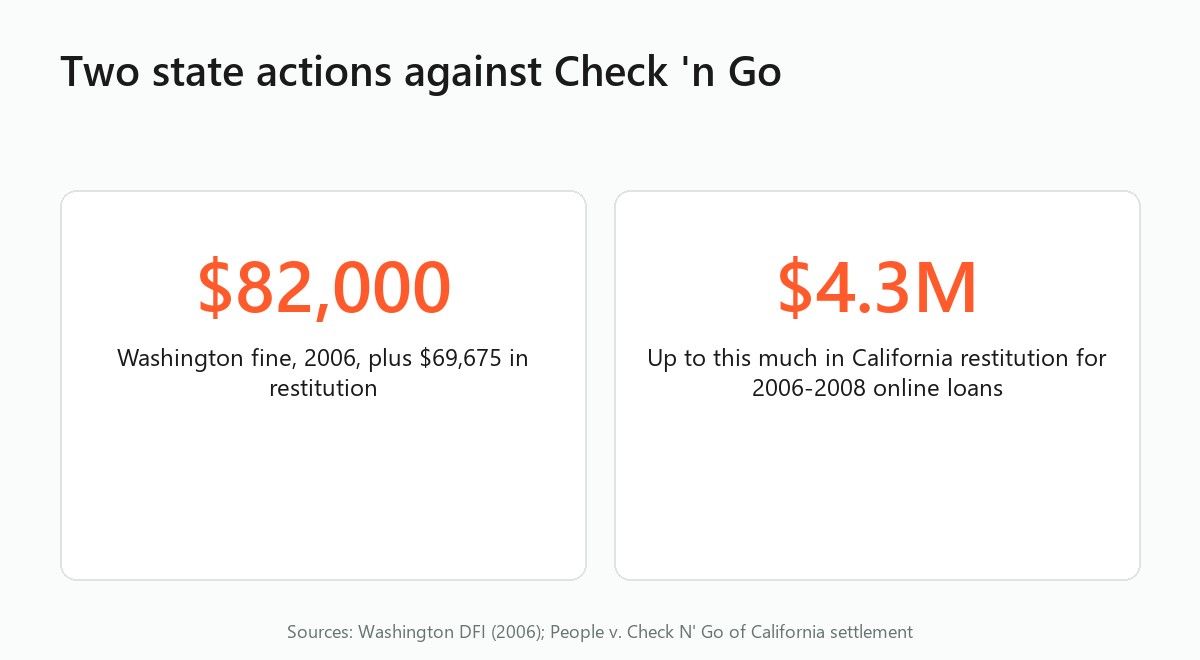
Washington, 2006. The Department of Financial Institutions found that Check 'n Go of Washington required multiple checks per loan, overcharged fees, and collected PINs without consent. The settlement, finalized December 27, 2006, cost the company $82,000 in fines, $69,675 in consumer restitution, and $5,800 in investigation costs, per Washington's Department of Financial Institutions.
California, filed 2007, resolved through 2012. Then-San Francisco City Attorney Dennis Herrera sued Check N' Go of California in San Francisco Superior Court, case number CGC-07-462779 (People of the State of California ex rel Dennis Herrera against Check N' Go of California and related defendants). The suit alleged the company used a rent-a-bank arrangement with First Bank of Delaware to issue online installment loans at rates as high as 400%, sidestepping California's rate cap at the time.
The resulting settlement made up to $4.3 million in restitution available to California borrowers who'd taken out online loans between November 2006 and June 2008, with individual refunds ranging from $20 to more than $4,600. Check 'n Go launched a three-month outreach campaign to notify eligible borrowers starting December 27, 2012.
North Carolina is part of the company's history too, though the documentation trail is thinner. Check 'n Go agreed years ago to stop making payday loans in the state, a fact consistent with North Carolina's current de facto ban on payday lending.
No CFPB federal enforcement action against Check 'n Go, Axcess Financial, or its historical corporate affiliates turned up in the research for this review. That absence isn't proof of a clean record, just an accurate statement of what a public search returns as of this writing.
California's Department of Financial Protection and Innovation maintains its own enforcement records by lender. This review could not load those records directly to confirm whether any additional state action exists beyond the two settlements above. Check the DFPI's own enforcement page directly if that history matters to your decision.
What Borrowers Report
Check 'n Go's Cincinnati, Ohio BBB profile shows an A+ rating but no accreditation, and it operates under multiple separate BBB profiles by state and entity (South Bend, Yakima, Kansas City, Bensenville, among others). Across those fragmented listings, hundreds of complaints have been logged in total, with recurring themes rather than a single precise count worth citing.
Borrowers frequently describe autopay debits landing on the scheduled due date even after they'd already made an early payment, which reads to the borrower like a double charge. Collection calls after a missed payment come up often enough in complaint narratives to count as a pattern, described as frequent or aggressive.
A theme that shows up across payday and CSO lender reviews generally, not unique to this company: satisfaction with how fast the money arrived, paired with surprise at how much total interest ended up owed. That gap between expectation and total cost is exactly what the disclosure page exists to prevent, if a borrower actually stops to read it.
The federal Consumer Complaint Database is a separate resource worth knowing about even though this review couldn't pull a reliable current count for Check 'n Go from it. You can search the database yourself before applying, and file your own complaint through it later if something about your loan doesn't match what you were told.
Read the Disclosure Before You Sign
That single page is where the real cost of the loan lives. Read the total finance charge line before the relief of fast cash convinces you the number doesn't matter.
If a lender rushes you past that page, or a storefront employee can't explain why the CSO fee is separate from the loan's interest rate, that's a signal to slow down, not a formality to sign through. A lender confident in its pricing will walk you through the math without prompting.
Ask for the total finance charge in dollars, not just the rate. A loan that sounds manageable at a quoted percentage can look very different once you see what it actually costs you in cash by the time it's repaid.
The Verdict: When to Use It, When to Walk
A Check 'n Go loan, like most payday or CSO products, makes sense in a narrow set of circumstances: a specific, one-time shortfall, a documented ability to repay in full on your very next paycheck, and no cheaper option available to you that week. Outside that limited window, the math tends to work against you, particularly in a state like Texas where the CSO fee structure sits outside the state's own interest-rate cap.
Before you apply anywhere, check whether your credit union offers a Payday Alternative Loan. Federal credit unions can offer PAL loans capped well below what storefront payday lenders charge. Membership itself is usually the only real barrier, and it's worth clearing that barrier before an emergency forces your hand. See the site's PAL comparison for how the costs stack up.
If you've already borrowed and something about your loan doesn't match what you were told when you signed, you can file a CFPB complaint against the lender directly, and the CFPB shares complaints with the company and other regulators.
If you do decide Check 'n Go or a lender like it is your best option this week, read every line of the disclosure, confirm the product and fee schedule on the lender's own current state page rather than a screenshot someone posted online, and have a specific repayment date circled before you sign. And if you want to see how three other storefront lenders compare on fees, that's a separate breakdown worth reading before you commit to any one of them.
Frequently Asked Questions
Is Check 'n Go a legitimate lender?
Check 'n Go is a licensed multi-state consumer lender with a documented regulatory history: a December 2006 Washington settlement that cost the company $82,000 in fines and $69,675 in restitution, and a California lawsuit that made up to $4.3 million in restitution available to borrowers starting in 2012. Being licensed doesn't mean every loan it offers fits your situation.
Does Check 'n Go operate as a direct lender in Texas?
No. In Texas, Check 'n Go registers as a Credit Services Organization and functions as a Credit Access Business, arranging loans from a third-party lender at a nominal 10% rate while charging its own separate CSO fee. That fee sits outside the state's direct-lender interest cap.
Has Check 'n Go faced state enforcement actions?
Yes. Washington's Department of Financial Institutions fined Check 'n Go $82,000 and ordered $69,675 in consumer restitution in a December 2006 settlement over billing and consent violations. California's then-San Francisco City Attorney sued the company over a rent-a-bank arrangement, resulting in up to $4.3 million in restitution made available starting in 2012.
What states does Check 'n Go operate in?
As of this article's publish date, Check 'n Go offers online lending in fourteen states including Texas, California, and Michigan, with storefronts in most of those states except California, Florida, Indiana, and Kansas. Confirm current availability on Check 'n Go's own state page before applying.
What do Check 'n Go complaints typically describe?
Public BBB records across Check 'n Go's state and city listings describe recurring issues: autopay debits hitting the original due date even after an early payment, frequent collection calls following a missed payment, and frustration with total interest charged. That last theme, satisfaction with speed paired with surprise at total cost, is common across payday and CSO lenders generally.
Is there a better alternative to a Check 'n Go payday loan?
A federal credit union Payday Alternative Loan is usually the better option if you're eligible: it caps costs well below typical storefront payday pricing. You'll generally need to already be a member of the credit union, sometimes for a short waiting period, so it's worth checking your own eligibility before you need the cash urgently, not after.