


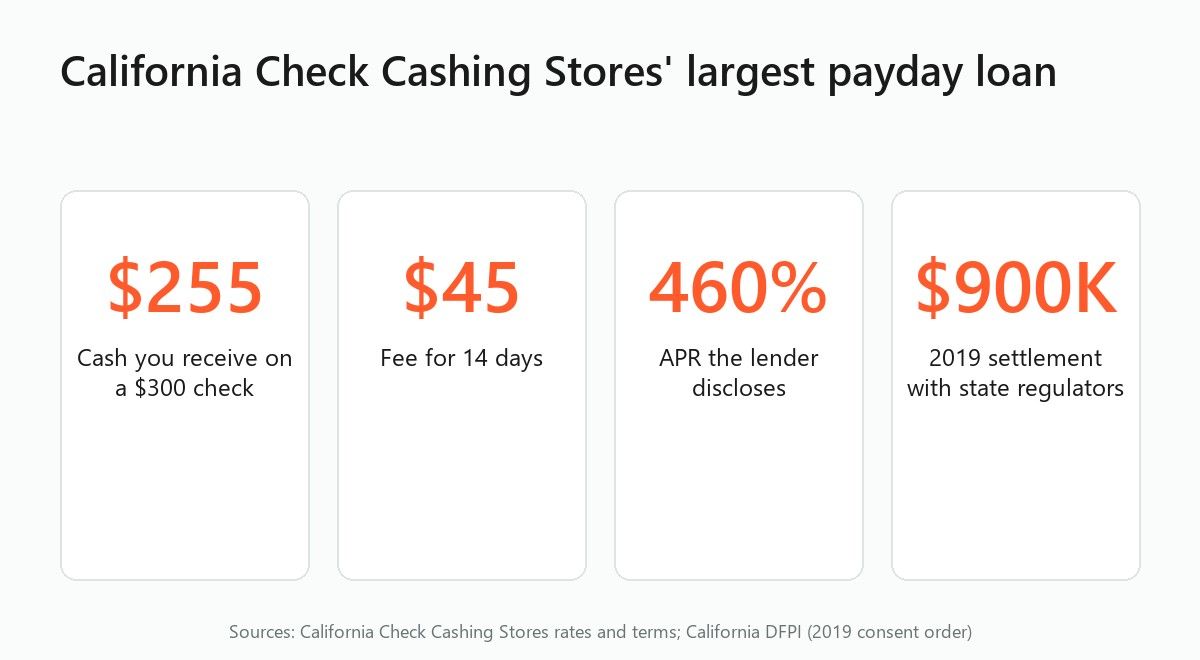
CCCS's own Rates and Terms page puts it plainly: borrow $255, repay $300, in two weeks if you're using the loan the way the example is built. CCCS prints that fee directly on its own site, and it's the fact worth checking before you take a California Check Cashing payday loan.
This review looks at California Check Cashing Stores (CCCS) as its own operation, distinct from the broader field of California payday lending. If you want the statutory background on the state's $300 loan cap and the 15% fee formula, the site already has that covered in California's payday loan rate cap. What follows here is narrower and more concrete: what CCCS discloses about its own product, who actually owns the company, whether it's licensed the way it claims, and what California regulators alleged when they investigated it.
What California Check Cashing Stores Actually Offers
CCCS's payday product, which the company calls a deferred deposit transaction, tops out at $255. That ceiling isn't a CCCS policy choice. California Financial Code section 23035 caps deferred deposit transactions at $255 for a total check or debit of $300, and CCCS's own Rates and Terms page cites that statute directly: "California law dictates Deferred Deposit Transactions cannot exceed $255.00 for a total check or debit amount of $300.00. The fee is 15% of the amount of the check or debit provided to the lender."
Here's the chart as CCCS publishes it, unedited:
- $100.00 provided, $17.64 fee, $117.64 total check or debit, 459.90% APR at 14 days, 214.62% APR at 30 days.
- $200.00 provided, $35.29 fee, $235.29 total check or debit, 460.03% APR at 14 days, 214.68% APR at 30 days.
- $255.00 provided, $45.00 fee, $300.00 total check or debit, 460.08% APR at 14 days, 214.71% APR at 30 days.
Notice how little the APR moves across loan sizes. California's fee is a flat 15% of the amount advanced. A borrower taking $100 and a borrower taking $255 pay functionally the same rate. The APR simply expresses that same 15% fee over a shorter or longer clock, which is why it swings from roughly 460% at two weeks to roughly 215% at a month.
If you want the full mechanics of how a flat dollar fee becomes a triple-digit APR, the site's own explainer on how payday APR is calculated walks through the formula step by step. CCCS's rate page shows the same math worked out at three loan sizes, so a borrower can check the arithmetic against what the disclosure claims before signing.
One thing CCCS does not disclose is a fixed loan term in days. The 14-day and 30-day columns on the rate chart function as examples. CCCS's own language ties repayment to "on or around your pay date," so the actual due date depends on the borrower's own pay schedule. That distinction matters if your pay cycle runs longer than two weeks: the fee stays $45 on a $255 loan either way, but the effective annual rate drops the longer you have the money.
Storefront vs Online: What "Start Online" Really Means
CCCS operates more than 70 storefront locations across California, a figure the company states consistently across its About Us and Payday Loans pages. That storefront count is large enough that most California borrowers searching for CCCS specifically will find a physical location within reasonable driving distance, not just a website. Every one of those pages also carries a "Start Online" button next to "Find a Store," so the company presents both paths as live options rather than treating the storefront network as a legacy channel it's phasing out.
What "Start Online" delivers in practice is a harder question to answer from the outside. CCCS's site doesn't spell out whether every online application can finish without a store visit.
Treat the online path as a way to start the paperwork; it is not confirmed to guarantee fully remote funding. If getting cash without walking into a location matters to your plans, call the specific store first and ask directly how their online process actually works before you count on it.
Who Owns California Check Cashing Stores
CCCS's marketing pages don't advertise their ownership, but California's regulator laid it out plainly in its enforcement announcement. The Department of Financial Protection and Innovation (DFPI)'s press release states that "California Check Cashing Stores is a subsidiary of Direct Financial Solutions, LLC, which is owned by Community Choice Financial, Inc."
Knowing the parent company matters here: it's worth knowing whose balance sheet stands behind the storefronts you'd be walking into, and it's the same chain that shows up again in the DFPI consent order below.
Is California Check Cashing Stores a DFPI-Licensed Payday Lender?
Every page on CCCS's site carries the same footer disclosure: "Company is licensed by the California Department of Financial Protection and Innovation pursuant to California Deferred Deposit Transaction Law, Cal. Fin. Code §23000 et seq." That's a specific statutory citation, and it matches the framework CCCS itself operates under.
What this review couldn't independently pin down is CCCS's exact license number. DFPI's public licensee search tools returned an automated access check rather than a usable result during research for this piece. Verify the current license status yourself rather than taking a number printed in any article on faith; DFPI's own lookup tool is publicly available.
Before you sign anything at a CCCS location, or any California Deferred Deposit Transaction Law (CDDTL) storefront, run the company's name through DFPI's public license search yourself. It's the only way to know the license is current on the actual day you're borrowing.
A statutory citation in a footer tells you the lender knows which law applies to it. Confirming the license is currently active, in good standing, and free of open enforcement action requires checking the regulator's own database directly.
The 2019 Consent Order: What California Regulators Alleged
This is the part of CCCS's record that doesn't show up on the company's own website. On January 22, 2019, the California Department of Business Oversight, the agency that later became DFPI, announced a $900,000 consent order settlement with California Check Cashing Stores, LLC. The order resolved allegations covering two categories, one tied to installment lending and one tied to payday loans. On top of the refunds described below, CCCS agreed to pay $105,000 in costs and penalties.
On the California Financing Law side, the state alleged CCCS steered borrowers into installment loans over $2,500 specifically because loans above that threshold escape CFL's interest rate caps. The regulator also alleged CCCS advertised "loans up to $5,000" in its brochures while its actual CFL minimum loan size was $2,501, which the state characterized as false or misleading advertising. CCCS agreed to refund roughly $100,000 across about 1,200 of those consumer loans.
The payday side of the order resolved separate allegations that CCCS double-collected charges on about 3,000 transactions, allowed customers to take out new payday loans before older ones were repaid, and deposited some borrowers' checks before the agreed due date without written authorization. CCCS agreed to refund approximately $700,000 across those roughly 3,000 payday transactions.
Put the two categories together and you get roughly 4,200 California transactions the order alleged CCCS owed refunds on, tied to alleged conduct across CCCS's payday and installment lending.
None of CCCS's current marketing pages mention this order. That's not unusual; companies rarely advertise their own consent orders. It's also exactly why an independent check against DFPI's own record matters more than reading a lender's About Us page and stopping there. A borrower relying only on CCCS's own site would have no way to know this settlement happened at all, since the rate chart and license footer are the only regulatory-adjacent details the company volunteers.
Context matters here too. CCCS wasn't singled out. The same regulator reached four parallel settlements with Speedy Cash, Advance America, Check Into Cash of California, and Quick Cash Funding between December 2017 and October 2018, then settled with CCCS in January 2019, all over similar rate-cap evasion allegations.
If you're cross-shopping, the site's comparison of Speedy Cash, Advance America, and CashNetUSA fees is a useful next stop. Speedy Cash and Advance America both had their own, separate consent orders in that same enforcement wave, with their own dollar figures. Don't mix them up with CCCS's numbers, and don't read the pattern as proof of an industry-wide conspiracy: those settlements show regulators were actively enforcing the rate cap during that period, which is not the same thing as proof about how every storefront lender behaves today.
No Installment Loan on CCCS's Current Site
The 2019 consent order describes CCCS's California Financing Law installment lending business as it operated in 2014, and it's the one tied to the $2,500-threshold steering allegations resolved in that order.
Today's public-facing CCCS site tells a different story. Its Financial Services page lists exactly six offerings: check cashing, bill payment, Western Union money transfers, money orders, tax prep help, and a Green Dot Visa debit card. No installment loan appears anywhere on that list, and the company's own "Our Loans and Services" page likewise describes only the $255 payday product as an active loan offering. This review found no current installment loan offering anywhere on CCCS's live site.
The Verdict
Judged only on what CCCS discloses about its $255 payday product, the company looks like a standard, statute-compliant CDDTL lender. CCCS's fee matches the statutory 15% formula exactly, the APR math checks out, and the license citation points to the right statute.
The 2019 consent order is where the picture gets more complicated. A $900,000 settlement covering roughly 4,200 transactions, with specific allegations of steering borrowers past a rate-cap threshold and depositing checks early without authorization, is a real regulatory matter, not a technicality.
It's also a single action from one investigation period, resolved seven years ago, alongside four competitors facing similar allegations in the same window. Call that a clean-but-dated blemish: the current record here can't support more than that, since a single resolved order carries less weight than an open investigation or a repeat pattern of fresh complaints would.
If you're going to use CCCS, or any CDDTL storefront, do two things first. Confirm the license is active through DFPI's own search tool rather than trusting a footer disclosure or an article, and read the rate chart in the store or online before you sign. The $255 loan and the $17.64-to-$45.00 fee range are exactly what the disclosures promise, no more and no less. Those two checks cost nothing, and they're the same checks a reporter runs before writing a review like this one.
If a $255 loan for two weeks isn't the right tool for your situation, a PAL loan from a credit union is a lower-cost alternative worth checking first. And if something about your own transaction doesn't match what was disclosed on paper, filing a complaint against a lender is a documented process, not a shot in the dark.
Frequently Asked Questions
Is California Check Cashing Stores a licensed payday lender?
CCCS states on every page of its site that it's licensed by California's Department of Financial Protection and Innovation under the California Deferred Deposit Transaction Law, Cal. Fin. Code §23000 et seq. Verify any specific license number yourself through DFPI's public licensee search rather than relying on a website footer.
How much does a $255 payday loan from CCCS cost?
Per CCCS's own Rates and Terms page, a $255 advance carries a $45.00 fee for a total check or debit of $300.00, which works out to roughly 460% APR over a 14-day example period or about 215% APR over 30 days.
Can I get a payday loan from California Check Cashing Stores entirely online?
Every page on CCCS's site carries a "Start Online" button next to "Find a Store," alongside its 70-plus physical locations. CCCS's site doesn't confirm that every online application can fund without a store visit. Call your local location and ask how their online process works before you count on skipping the store.
Has California Check Cashing Stores been fined by state regulators?
In January 2019, California's Department of Business Oversight, now DFPI, reached a $900,000 consent order with CCCS resolving allegations of loan steering, double-charging on payday transactions, and early check deposits, covering roughly 4,200 transactions combined. Of that total, $105,000 was costs and penalties; the rest was refunds to borrowers.
Does California Check Cashing Stores still offer installment loans?
Not according to its current public site. CCCS's Financial Services and Our Loans and Services pages list only the $255 payday loan and non-loan services like check cashing and money transfers. The installment loan business referenced in the 2019 consent order describes CCCS's operations from 2014; the company's live site today advertises no such product.
Who owns California Check Cashing Stores?
According to DFPI's January 22, 2019 press release, CCCS is a subsidiary of Direct Financial Solutions, LLC, which is owned by Community Choice Financial, Inc. CCCS's own marketing pages don't disclose this ownership chain anywhere; the information comes solely from the state regulator's enforcement announcement.