




Search "bank of america payday loan" or "bank of america payday advance" and you will not find one. Bank of America does not sell payday loans. What it sells instead is Balance Assist, and the terms changed this year in a way most of the internet has not caught up to yet.
The flat fee jumped from $5 to $15, and the repayment window stretched from three months to four. That is confirmed on Bank of America's own current banking solutions page, not on the review sites still quoting 2024 numbers. This matters because Balance Assist is not alone anymore.
Wells Fargo and U.S. Bank each run their own version of a checking-account small-dollar bank loan. The three products do not cost the same thing despite sounding interchangeable. One of them costs more than double the cheapest option's lowest rate, and it is probably not the one you would guess.
Why Banks Don't Call It a Payday Loan
National banks answer to the Office of the Comptroller of the Currency, not to the state payday-lending statutes that license storefront lenders. That is the entire reason Balance Assist, Flex Loan, and Simple Loan can charge a fee that functions like a payday fee without tripping a state payday license requirement. They are regulated as small-dollar bank loan products under federal banking rules, not as payday loans, even in states with a strict payday-lending cap.
That distinction is more than a technicality for anyone comparing the two categories. A storefront payday lender has to register with your state's regulator and follow that state's fee cap, if one exists. A national bank does not answer to that same regulator for a product like Balance Assist, so the fee structure you see is set by the bank itself rather than by a state usury statute.
Bank of America underscored that separation in 2020, when it filed a no-action letter request with the Consumer Financial Protection Bureau specifically covering Balance Assist, a regulatory step a state-licensed payday lender does not go through.
The cost mechanics happen to rhyme with a payday loan's even though the legal category is different. Missed payments work differently too. U.S. Bank's Simple Loan carries no NSF or late fee, according to its own knowledge base, a different consequence structure than what borrowers typically face at a payday storefront.
Balance Assist vs. Flex Loan vs. Simple Loan vs. a Payday Loan
Here is how the three verified bank products compare against each other and against a typical payday loan, on amount, fee, APR, term, and who qualifies.
- Bank of America Balance Assist: up to $500, $15 flat fee, effective APR of 14.32% to 23.77%, repaid over four monthly payments. Available to checking account customers; SafeBalance Banking for Family Banking accounts are excluded.
- Wells Fargo Flex Loan (as reported by NerdWallet, not confirmed on a Wells Fargo page): $250 for a $12 fee or $500 for a $20 fee, repaid in four monthly installments, with an APR NerdWallet calculates at 22.82% for the $250 loan and 19.05% for the $500 loan. According to NerdWallet's reporting, Wells Fargo offers it only to existing customers, checked for preapproval through the mobile app.
- U.S. Bank Simple Loan: $100 to $1,000 in $100 increments, $6 fee per $100 borrowed, approximately 35.6% APR, repaid in three monthly payments. Requires a U.S. Bank checking account open at least six months, plus a 30-day wait between loans.
- Typical payday loan: a fee of $15 per $100 borrowed, working out to roughly 391% APR on a standard two-week term, due in one lump payment on your next payday.
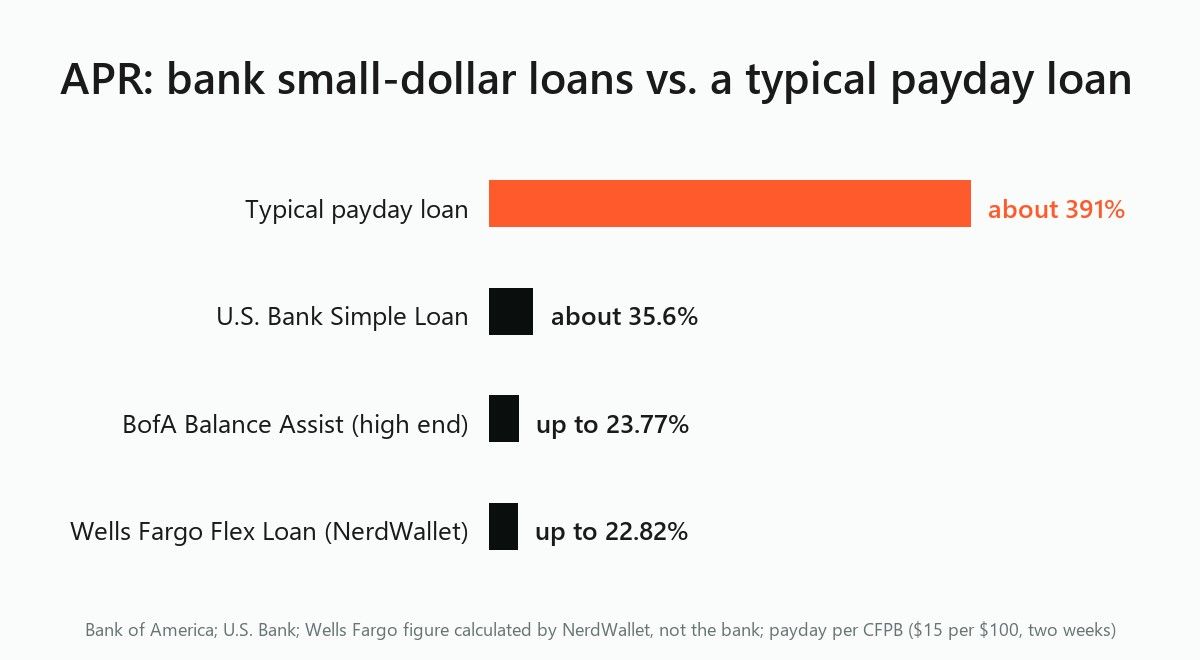
Read that list twice and one thing jumps out. U.S. Bank Simple Loan, the one with the friendliest-sounding name, carries the highest APR of the three verified bank products. Cheapest-sounding name, priciest bank loan.
Remember that before you assume any bank small-dollar product is automatically your lowest-cost option just because it comes from your own bank. The fee structure determines what a loan actually costs; the product name means nothing. All three still beat a payday storefront by a wide margin, but they are not identical to each other.
Bank of America Balance Assist, in Detail
Balance Assist lets checking account customers borrow up to $500 for a flat fee, according to Bank of America's own consumer banking page. There is a $15 fee for opening a Balance Assist loan and there are no other interest or finance charges, per that same source. The $15 fee translates into an effective APR of 14.32% to 23.77% depending on how much you borrow. Repayment runs over four months.
Bank of America walks through a worked example directly on its page: a $300 loan totals $315, split into four equal monthly payments of $78.75, working out to a 23.77% effective APR. SafeBalance Banking for Family Banking accounts are explicitly excluded from eligibility. Source: Bank of America, "Balance Assist and SafeBalance Solutions," info.bankofamerica.com.
Here's what makes this genuinely new. The version of Balance Assist that still dominates search results, the one cited by NerdWallet, WalletHub, Forbes Advisor, and Credit Karma reviews, charged a $5 flat fee and gave borrowers three months to repay. That version no longer exists.
Bank of America's current page shows only the $15 fee and the four-month term, with no trace of the old $5 pricing. If you're comparing Balance Assist against other options using numbers pulled from an older review, you're comparing against a product Bank of America stopped offering.
Wells Fargo Flex Loan, in Detail
Searches for "payday loans wells fargo" tend to land on Flex Loan. Wells Fargo does not appear to run a public marketing page for it on wellsfargo.com. According to NerdWallet's review of the product, that lines up with how it actually works: Flex Loan is an invitation-only offer that surfaces inside the mobile or online banking app for customers Wells Fargo has already identified as eligible, checked through the app rather than an outside application page.
Because there is no live Wells Fargo product page to cite directly, the fee figures here come from NerdWallet's review of Flex Loan rather than from Wells Fargo's own disclosures. NerdWallet's Wells Fargo Flex Loan review reports that Flex Loan offers $250 for a $12 fee or $500 for a $20 fee, repaid in four monthly payments, with no separate application, no interest charge, and no late fee.
NerdWallet calculates the resulting APR at 22.82% for the $250 loan and 19.05% for the $500 loan. Those are NerdWallet's own calculations, not figures Wells Fargo discloses anywhere this research turned up, so read them as a reviewer's math rather than a bank-stated rate.
U.S. Bank Simple Loan, in Detail
Simple Loan is the most flexible of the three by dollar amount. According to U.S. Bank's own knowledge base, you can borrow between $100 and $1,000, in $100 increments, a wider range than either Balance Assist or Flex Loan. The cost is $6 for every $100 borrowed, which the bank itself states works out to approximately 35.6% APR.
You repay the loan in three monthly payments, the shortest term of the three bank products. Eligibility requires a personal checking account with the bank that has been open at least six months.
Once you pay off a Simple Loan, the bank makes you wait 30 days before you can take out another one, according to U.S. Bank's own knowledge base article on Simple Loan.
That 35.6% APR is the number worth sitting with. It is still nowhere near payday loan territory, but it is more than double Balance Assist's lowest rate (14.32%) and well above the calculated Flex Loan rate. Simple Loan's larger borrowing ceiling, wider $100-to-$1,000 range, and shorter three-payment repayment window come at a real cost premium compared to the other two.
Do Truist and Chase Offer a Small-Dollar Bank Loan?
Truist does not sell a proactive small-dollar loan comparable to the three products above. What it offers is overdraft-related credit, a safety net that activates when your account goes negative rather than something you request ahead of a cash shortfall. That is a fundamentally different mechanism from applying for a Balance Assist or Simple Loan before you're short on funds, and this article does not cover it further because the specific terms are not verified on Truist's own site.
Chase does not offer a checking-account small-dollar loan either. Searches for "chase payday loans" typically surface one of two unrelated products. My Chase Loan converts existing Chase credit card credit into an installment loan starting at $500, which means it requires an existing Chase card and available credit limit. It is a credit card product, not a checking-account loan, and it works nothing like Balance Assist.
The second product, Chase Secure Banking's "early payday" feature, is not a loan at all. It releases a direct deposit you're already owed up to two days early, with no borrowing and no fee attached.
Chase, the largest U.S. bank, simply does not have a product in the same category as Balance Assist, Flex Loan, or Simple Loan. If you bank with Chase and were hoping for a checking-account version of Balance Assist, no such product exists, so a credit union or one of the three banks above is the closer comparison.
How This Stacks Up Against an Actual Payday Loan
Every one of these bank products, even the pricier Simple Loan, costs a fraction of what a storefront payday loan costs. The math behind that gap explains why. This site has already broken down how a $15-per-$100 fee becomes a 391% APR, and that same pricing is a common storefront fee.
Compare that to Bank of America charging $15 flat on a loan up to $500, not $15 per $100, and the gap in cost per dollar borrowed becomes obvious fast. A borrower who takes the full $500 from Balance Assist pays $15 total. The same $500 from a payday lender at $15 per $100 would cost $75, five times as much, before any rollover fee ever enters the picture.
The repayment structure matters as much as the rate. A payday loan is typically due in full on your next payday, a single balloon payment that pushes many borrowers toward a rollover. All three bank products spread repayment across three or four monthly installments instead. The installments change how the debt behaves, which a lower price alone would not.
How to Check If You're Eligible
According to NerdWallet's reporting, Wells Fargo's Flex Loan only appears for customers the bank has already identified as pre-qualified. If you don't see an offer in the app, there is no outside application to fill out instead. That invitation-only design is the single biggest practical difference among the three products.
If your bank is not one of these three, or your account has not been open long enough to qualify, a credit union may be worth a call before a payday storefront. Many credit unions offer a credit union PAL loan. And if overdraft fees are part of what's pushing you toward a short-term loan in the first place, check whether banks that dropped overdraft fees entirely would solve the underlying problem before you borrow at all.
Frequently Asked Questions
Does Bank of America offer payday loans?
No. Bank of America does not sell payday loans. Its comparable product is Balance Assist, which, according to Bank of America, lets checking account customers borrow up to $500 for a flat $15 fee, repaid over four monthly installments, with an effective APR between 14.32% and 23.77% depending on the amount borrowed.
What is Balance Assist and how much does it cost?
Balance Assist is Bank of America's small-dollar loan for checking customers. According to Bank of America, it charges a flat $15 fee with no other interest or finance charges, regardless of how much you borrow up to the $500 limit, and you repay it in four equal monthly payments.
Can I get a Wells Fargo Flex Loan without the app?
No. According to NerdWallet's reporting, Flex Loan is an invitation-only offer that appears inside Wells Fargo's mobile or online banking app for customers the bank has already identified as eligible. There is no separate application page, so if the offer doesn't appear in your app, it isn't currently available to you.
Which bank small-dollar loan has the lowest APR?
Among the three verified bank products, Bank of America's Balance Assist carries the lowest disclosed APR range, 14.32% to 23.77%. U.S. Bank's Simple Loan carries the highest at approximately 35.6%, partly because its three-month term is the shortest of the three.
Do Chase or Truist offer a payday loan alternative?
Neither bank offers a checking-account small-dollar loan comparable to Balance Assist, Flex Loan, or Simple Loan. Chase's My Chase Loan borrows against existing credit card credit, a different product entirely, and Truist's overdraft credit line activates only after an account goes negative rather than on request.